How women collectors shape culture
From personal taste to public culture: understanding the reach of collecting
A reading of collecting as cultural participation: whom collectors support, how relationships form, and what they want their collections to contribute.
Original research · STELLA Alliance × ArtTactic
Reading & commentary · Art Value Lab
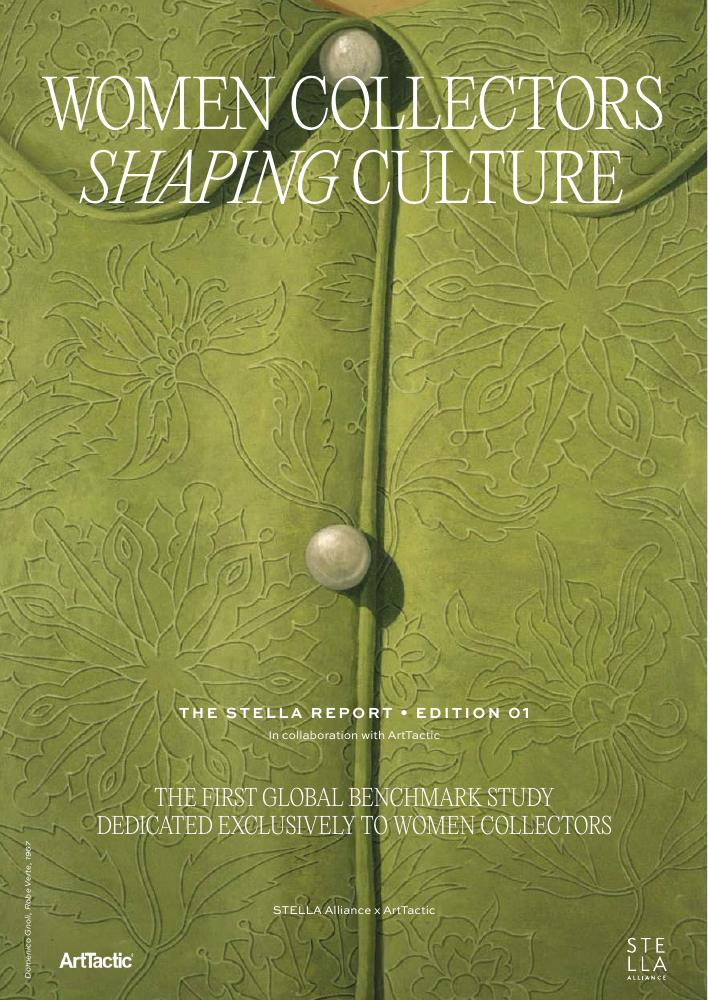 The STELLA Report · Edition 01 — Women Collectors Shaping Culture
- Collecting can translate personal values into resources and sustained artist support.
- Studios, networks and institutions extend influence beyond a purchase.
- Survey patterns describe a particular audience, not fixed characteristics of women or men.
Figures refer to the source samples and survey period; expectations are not realised outcomes.
Ask while reading: beyond visibility, what kind of sustained support could my collecting or platform work provide?
How collecting participates in culture
An acquisition can affect more than ownership. It may support future production, help a gallery continue its programme, or lead to loans, research and public collections. Collecting connects taste with the allocation of attention and resources.
The first STELLA report centres women collectors and asks whom they support, how they form relationships and what they want their collections to contribute. It places this inquiry against a background of changing wealth ownership.
Wealth forecasts and collector surveys are different forms of evidence. Greater resources do not automatically produce greater representation: decisions, institutional arrangements and sustained action matter.
Take with youFollow works, relationships and institutions together.
Source report pages · 2–6, 10–11Aesthetic attraction and personal values
Aesthetic value motivates 75% of women respondents and 72% of men. This shared starting point matters: gender comparisons should not obscure the visual and emotional encounter with an artwork.
Investment value motivates 24% of women and 36% of men, rising to 28% and 48% respectively among respondents under 45. These differences do not mean that women ignore financial questions or that men collect only for return.
Extremely strong values alignment is reported by 45% of women and 24% of men. Among younger women, 42% report very strong alignment and another 42% extremely strong alignment. The combined 84% uses a broader response category and should not be directly compared with the 45% figure.
Percentages of respondents. Questions differ; motivations can overlap and are not spending shares.
Take with youA collector’s priorities are better understood in combination than through a single label.
Source report pages · 8, 14–16Buying activity and living artists
Over the preceding two years, 30% of women respondents reported buying more, compared with 14% of men. Under 45, the figures were 37% and 17%. These are shares of respondents reporting a change, not sales-value growth rates.
Contemporary art is collected by 77% of women respondents, with 37% engaging with ultra-contemporary art. Historical categories also appear: collecting across periods is possible, so the categories are not exclusive.
Supporting living artists can involve primary-market purchases, commissions and other resources. A purchase of a living artist’s work does not necessarily send the transaction proceeds directly to that artist.
Take with youMore buying, more spending and direct artist benefit are different questions.
Source report pages · 15, 17Studios, recommendations and trust
Commercial galleries are a discovery channel for 68% of both women and men. The sharper differences appear in studio visits and recommendations.
Studios are cited by 42% of women and 27% of men; friends and word of mouth by 52% and 38%. Encounters with materials, unfinished work and research can make artistic decisions more intelligible.
Networks can help people navigate information, but familiarity should not replace judgement. Close networks may also concentrate access among those already connected.
Report page 19. Multiple channels can be used; percentages are not additive market shares.
Representation and cultural memory
Collecting underrepresented artists is very or extremely important to 35% of women respondents and 14% of men. Underrepresentation concerns visibility in specific institutional and market contexts, rather than a single artistic style.
Long-term cultural narratives matter at this level to 48% of women and 38% of men. Among those under 45, however, the figures narrow to 46% and 45%. Overall differences should not be projected onto every subgroup.
Preservation, research, exhibition and acquisition collectively shape cultural memory. Attitudes towards representation do not by themselves establish that institutional collections have changed.
Take with youDistinguish commitments to representation from demonstrated changes in representation.
Source report pages · 12, 23–26Support beyond financial contributions
The report includes introductions, expertise, mentorship and visibility as forms of support. In-kind assistance is reported by 57% of women and 47% of men; visibility initiatives by 36% and 27%.
Among respondents under 45, 29% of women expect to expand into leadership or advisory roles within five years, compared with 11% of men. This measures intentions, not appointments or decision-making power already obtained.
Cultural stewardship directs attention to the conditions that allow work to continue. Introductions, workspace, research time and professional advice can address different stages of a practice.
Take with youAsk what support makes possible and how it can be sustained.
Source report pages · 18, 28When support becomes infrastructure
Fundación Ama Amoedo and the Cisneros Fontanals Art Foundation illustrate combinations of grants, residencies, commissions, collections and institutional partnerships supporting Latin American art.
Valeria Napoleone’s initiative with the Contemporary Art Society connects acquisitions of work by living women artists with donations to UK museums. Assessing its effects requires attention to the works, receiving institutions and subsequent public presentation.
Fondazione Sandretto Re Rebaudengo combines production, cultural education and curatorial development. The report also describes collective patronage networks that pool resources for projects and institutions.
Take with youDurable cultural contributions need functioning programmes and professional collaboration.
Source report pages · 24, 30–35Care includes preservation and responsibility
The professional perspective included in the report stresses protection from the first acquisition. Private collection management may not yet match institutional standards.
Preservation, condition records and appropriate expertise help works remain available for future research and presentation. Stewardship therefore involves continuing work as well as an aspiration.
Re Rebaudengo describes a collection’s narrative as developing through encounters and choices over time. Its later significance cannot necessarily be planned in advance.
Source report pages · 21, 32, 36Questions to put into practice
Artists can explain the question driving a practice, how works investigate it and the conditions needed for the next stage. This makes continuity visible beyond a single exhibition.
Galleries and institutions can offer different depths of participation, from accessible interpretation to studio conversations and sustained programmes with clear purposes.
Collectors can review the voices represented in their collections and the kinds of support they can sustain. Platforms might document substantive exchanges and subsequent collaborations alongside viewing figures. These are applications, not outcomes validated by the report.
Take with youChoose a concrete form of support and a way to review what it achieves.
Source report pages · 36–40The following editorial analysis explores mechanisms, practical approaches and open questions. It extends the source research without presenting new findings on behalf of its authors.
From motivations to resource allocation
Women in the sample more often emphasised value alignment and discovered art through studios and personal networks. Collecting can connect aesthetic choices with relationships and cultural support, but stated motivations do not fully explain purchases or predict later donations.
Age complicates gender comparisons. The gap in support for cultural narratives nearly disappears among respondents under 45. Generational experience and social networks may matter alongside gender; this survey cannot isolate their causal effects.
Our next question is whether attitudes become sustained resource flows. Repeat purchases, years of collaboration, production support and public access would help distinguish an intention to support from a durable support structure. Women collectors should not be treated as a group with one shared outlook.
Analysis references · source pages · 8, 14–20, 23–26After acquisition: turning collecting into public support
The cases extend collecting into education, residencies, production and institutional partnerships. Their significance lies in how works, expertise and networks are made available. Opening a collection to students addresses access; sustained foundation support addresses continuity.
These activities cannot be ranked simply by collection size. Access requires care and interpretation, donations require institutional capacity, and residencies require fair working conditions. Each entails recurring costs that acquisition totals do not capture.
A practical starting point is one clearly defined commitment: a production phase, a public acquisition or paid research access. This is our editorial suggestion rather than a proven formula. Artists and partner institutions should help evaluate whether the support meets their needs.
Analysis references · source pages · 18, 24, 28, 30–40Distinguishing attitudes, behaviour and impact
| Research signal | What it describes | What remains open |
|---|---|---|
| Extreme importance of alignment: 45% women, 24% men | Self-reported collecting motivation | Do spending and sustained support align? |
| Buying more: 30% women, 14% men | Reported changes in purchasing | How do volume, spending and recipients differ? |
| Expertise as support: 57% women, 47% men | Participation beyond financial contributions | How do recipients assess the support? |
A network survey of 268 collectors, not a representative sample of all collectors. The questions are Art Value Lab commentary.
How can you use this research?
Collectors
Track acquisitions, production support, expertise and public access separately, including continuity and recipient feedback. One monetary total cannot describe every contribution.
Museums and arts organisations
Define care, staffing and artist remuneration before discussing donations or visibility, so collector participation responds to real institutional needs.
What changes when we read these together?
Methodology & source
Conducted in November–December 2025 with 268 collectors: 56% women and 44% men, recruited through ArtTactic and STELLA Alliance client and mailing lists. Europe accounts for 44% and North America for 32%. The report explicitly states that the highly engaged sample is not statistically representative of global collectors. Attitudes and intentions are not realised outcomes. Male donation figures differ between pages 28 and 36; this guide does not use that comparison. Case studies are accounts in the report, not independently verified impact evaluations.
The STELLA Report · Edition 01 — Women Collectors Shaping Culture
STELLA Alliance × ArtTactic