Memory
Hiroshi Sugimoto · Hubbard/Birchler · Josiah McElheny · Mike Kelley · Susan Rothenberg
Whether critical, irreverent, or introspective, the artists in “Memory” delve into personal memory and the past, transforming them in their work. The artists wrestle with complex topics such as the veracity of history, the nature of interpretation, subjective versus objective truth, and the ways in which objects and images from the past embody cultural memory.
Introduced by actor Isabella Rossellini, “Memory” is shot on location in Galisteo, New Mexico; Los Angeles, California; Paris, France; New York, New York; Chicago, Illinois; and Austin, Texas.
Featured artists
About the artists
Central to Hiroshi Sugimoto’s work is the idea that photography is a time machine, a method of preserving and picturing memory and time. Sugimoto sees with the eye of the sculptor, painter, architect, and philosopher. He uses his camera in a myriad of ways to create images that seem to convey his subjects’ essence, whether architectural, sculptural, painterly, or of the natural world. He places extraordinary value on craftsmanship, printing his photographs with meticulous attention and a keen understanding of the nuances of the silver print and its potential for tonal richness—in his seemingly infinite palette of blacks, whites, and grays.
Teresa Hubbard and Alexander Birchler live and work in Austin, Texas, as life partners and artist-collaborators. Together they make short films and photographs about the construction of narrative time and space, without the context of a traditional story line; their open-ended, enigmatic narratives elicit multiple readings. They began their collaboration in the mid-1990s, making sculpture, installation, photography, and performance-based work. Their interest in the construction and negotiation of space, architecture, and the function of objects in three dimensions plays a primary role in their work. Their productions reveal a strong sense of carefully constructed mise-en-scène that owes as much to natural-history-museum dioramas as to cinematic directorial techniques.
Josiah McElheny creates finely crafted, handmade glass objects that he combines with photographs, text, and museological displays to evoke notions of meaning and memory. Whether recreating miraculous glass objects pictured in Renaissance paintings or modernized versions of non-extant glassware from documentary photographs, McElheny’s work takes as its subject the object, idea, and social nexus of glass. Influenced by the writings of Jorge Luis Borges, McElheny’s work often takes the form of “historical fiction”—which he offers to the viewer to believe or not. Part of McElheny’s fascination with storytelling is that glassmaking is part of an oral tradition, handed down generation to generation, artisan to artisan.
Mike Kelley’s work ranges from highly symbolic and ritualistic performance pieces to arrangements of stuffed-animal sculptures, to wall-size drawings, to multi-room installations that restage institutional environments (schools, offices, zoos), to extended collaborations. His work questions the legitimacy of “normative” values and systems of authority, and attacks the sanctity of cultural attitudes toward family, religion, sexuality, art history, and education. He also comments on and undermines the legitimacy of the concept of victim or trauma culture, which posits that almost all behavior results from some form of repressed abuse. Kelley’s aesthetic mines the rich and often overlooked history of vernacular art in America, and his practice borrows heavily from the confrontational, politically conscious, “by all means necessary” attitude of punk music.
Susan Rothenberg’s early work—large acrylic, figurative paintings—came to prominence in the 1970s New York art world, a time and place almost completely dominated and defined by Minimalist aesthetics and theories. Rothenberg’s paintings since the 1990s reflect her move from New York to New Mexico, her adoption of oil painting, and her new-found interest in using the memory of observed and experienced events as an armature for creating a painting. These scenes excerpted from daily life, whether highlighting an untoward event or a moment of remembrance, come to life through Rothenberg’s thickly layered and nervous brushwork.
Keep watching
 13:58
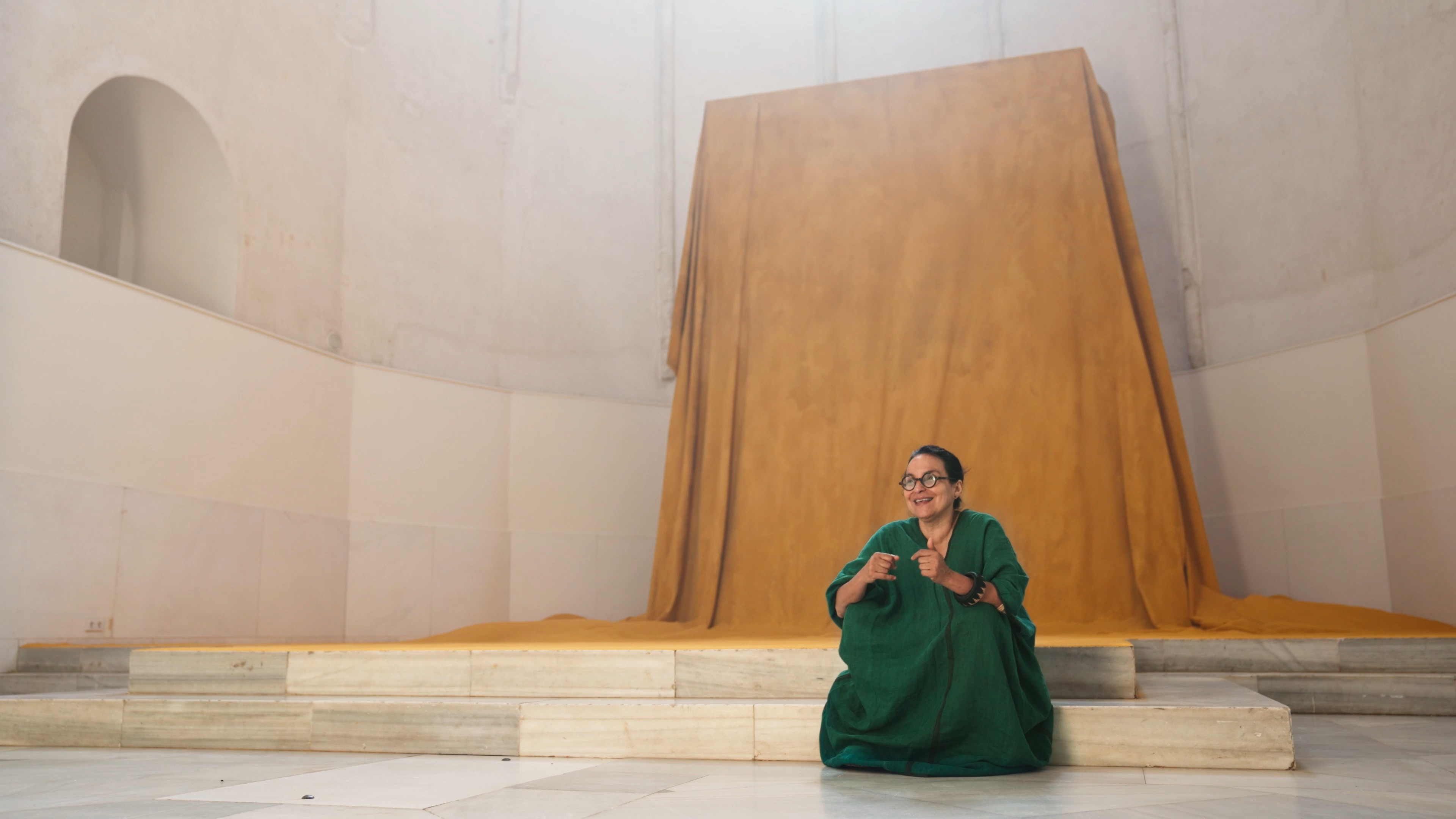
13:58Delcy Morelos in “Human Nature”
Delcy Morelos
 54:05
54:05Human Nature
Delcy Morelos · Lenka Clayton · Josh Kline · Sin Wai Kin
 14:08
14:08Josh Kline in “Human Nature”
Josh Kline