ART YOU READY · EXHIBITION GUIDES · 01 / 06
London Galleries: Materials, Bodies and Viewpoints
Autumn 2025 · Galleries in Marylebone, Mayfair and the surrounding areas
How sixteen artists use materials, figures and exhibition displays to give time a visible form.
Looking back at this round of exhibitions in London, I want to ground my responses in how the works are made, how they occupy space and how they position the viewer. The methods of these sixteen artists differ greatly, but together they gradually form a question that can be tested again and again: how does art make time, ordinarily so difficult to see, visible through changes in materials, bodies and space? Handmade seams, lines erased and printed anew, figures on the verge of coming apart and the viewing distances deliberately established by galleries all give this question a concrete form. These comparisons allow me to place an individual viewing experience back within an artist’s methods and the exhibition space, and to keep thinking from there.
How Materials Preserve Histories of Labour and Use
Hugh Hayden’s “Hughmanity” offers a clear starting point. He turns the uses of everyday objects into contradictions: the long table in “The Last Supper” is surrounded by flame-like forms, while the inside of the small boat in “The Good Samaritan” is covered with wooden spikes pointing towards its centre, leaving only a few areas smooth. Tables and boats ordinarily promise gathering, care and transport, yet the carving makes even the thought of approaching them difficult. For me, the key is that these familiar objects remain clearly recognisable while the treatment of their materials continually works against their original functions. The cost of joining a community thus becomes more than an abstract question; it becomes a question of the distance between a body and an object. The long table stands on a red patterned carpet. These domestic furnishings make it harder to dismiss the unapproachable forms simply as unfamiliar objects. Lisson Gallery exhibition text
Sonia Gomes and Sagarika Sundaram take this thread of material inquiry in a softer direction. In Gomes’s exhibition at Pace, stitching, binding and wrapping old fabrics extend the prior histories of the objects. The suspended work “Tereza” connects hanging forms originally conceived separately; its name also refers to escape ropes made by knotting together sheets and other fabrics. Her first bronze works cast the forms of fabric-wrapped branches in metal. In the gallery, pale wrapped forms descend from above and continue winding along the floor in front of a magenta wall. Once a line acquires weight, looking also requires following its knots and connections; a single frontal view can no longer encompass the whole form. The transition between softness and hardness makes me pay closer attention to how the gestures of labour are preserved: even when the material changes, the work can still be read through the rhythms of binding and wrapping. Pace exhibition text
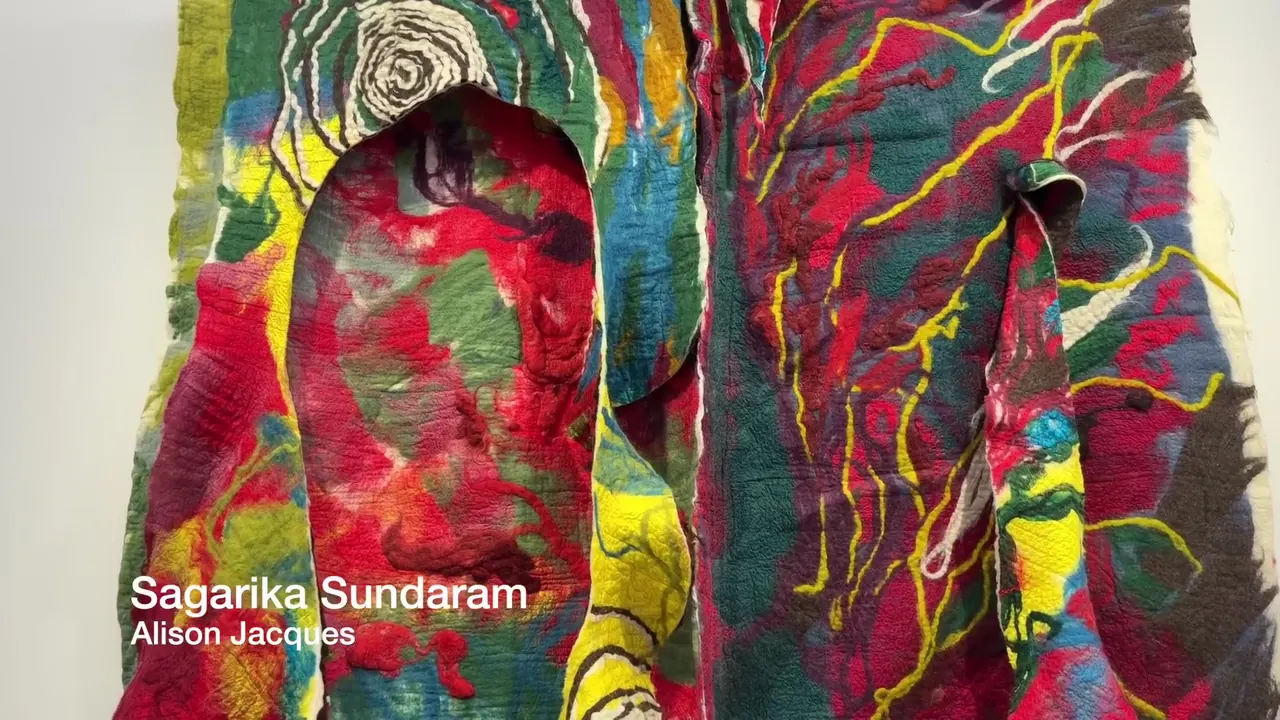
Sundaram’s “Release” at Alison Jacques begins with the tearing, pressing and felting of hand-dyed wool, followed by cuts that reveal the layers concealed within it. Openings in the surface give colour thickness and make the “inside” a place that can be seen. Up close, the turned-up edges of the fibres cast real shadows, and the cuts expose layers of different colours. In another lofty space, a square work hangs almost horizontally beneath a skylight. Colour thus has an orientation, and looking includes the actions of raising one’s head and identifying an underside. The exhibition also includes glass mosaics, reminding me not to sum up her practice solely in terms of fibre art. Placing her alongside Gomes reveals two different kinds of time: Gomes’s materials carry their previous use, while Sundaram’s layers progressively record the process of making. Understanding this distinction makes it possible to explain how fibre becomes structure, rather than stopping at adjectives such as soft, soothing or handmade. Alison Jacques exhibition and artwork information
Alexandre Diop’s “Run For Your Life !” at Stephen Friedman Gallery pushes assemblage towards a more abrasive surface. He burns, tears, nails and layers scrap metal, wood, leather and fabric fragments to make “object-images” that sit between painting and relief. Close views even reveal printed text from product packaging; the image does not erase a fragment’s previous use. From a distance, a body is recognisable. Up close, its interior breaks down into joined edges and heterogeneous surfaces. Looking therefore cannot stop at identifying a figure: the eye must also trace the places where disparate objects meet and where thickness interrupts the plane. I bring Diop, Gomes and Sundaram together to distinguish how materials enter their works, rather than compress different histories into a single narrative of identity. Reuse, wrapping and cutting open each propose a different way of preserving and rewriting. Artforum archive of the Stephen Friedman Gallery press release
How Painting Takes Shape and Resists Being Fixed
Christopher Wool’s exhibition at Gagosian shifts my attention from “What does this look like?” to “How many processes has this image undergone?” His works on paper draw on his own existing images, continuing to develop through printing, erasure, overpainting and digital alteration. Sculptures in copper-plated steel and bronze bring coiling lines into actual space. Marks on paper and joints in sculpture establish comparable rhythms. A single sightline can encompass a large linear sculpture and a distant grid of small works on paper: the former allows us to see through it, while the latter moves our gaze from one unit to the next. The space thus offers two ways to read similar lines, making changes of scale part of the thinking. Here, an original work can also become material for the next one. I therefore understand blurring and repetition as evidence of ongoing revision, rather than rushing to read them as spontaneous emotional release. Gagosian exhibition text
Ding Yi’s “The Road to Heaven” at Lisson Gallery also works with repeated signs, but his vocabulary of crosses has specific new conditions in this exhibition: Dongba paper, acrylic and water-soluble coloured pencils, alongside small carved units on basswood. Information from his studio connects these works to his research in Yunnan and the cultural context of the Naxi scroll “The Road to Heaven”. I retain this account in my reading while avoiding decoding the cross directly as a single religious symbol. The resistance of paper fibres and carved wood means that seemingly regular images still contain variations in handwork. Up close, dense crosses and diagonal lines are visible; from a distance, the large paintings resolve into multiple layers of angular bands of colour. I read between these two distances: the details have their own times of making, while a distant view produces a rhythm like an unfolding mountain landscape. Read alongside Wool, repetition can be both the reworking of an image and the readjustment of an existing form when it encounters a different material and body of knowledge. Ding Yi Art Studio exhibition information
Sabine Moritz’s “The Sleep of Tomorrow” at Pilar Corrias on Conduit Street brings abstraction and figuration, previously developed separately in her practice, into the same group of works. Female figures emerge through layers of colour, while their contours may merge back into the surrounding brushwork. This makes me more inclined to treat recognition as a process that unfolds over time. Faces, hands and female torsos can be identified, yet they are still made up of dense brushstrokes similar to those around them. A triptych further interrupts the flow of colour with narrow white gaps, requiring the eye to reconnect its parts. The figure is not first established and then supported by a background; the viewer must move back and forth between densities of colour and clues to form, gradually assembling a provisional body. Pilar Corrias exhibition text
Manuel Mathieu’s “Bury Your Masters”, held at the same gallery’s Savile Row space, is a separate exhibition. Its materials take this instability beyond the canvas: “In the heart of the revolution II” includes hanging fabric, while “Altar for your sins” combines ceramic, wire, fabric and other materials. The exhibition’s questioning of familial, political and spiritual inheritances thus has a material basis in joining and reassembling. Up close, folds and linear traces appear between pink, creamy white and black areas, differentiating parts of the “surface” that have been connected, pulled or partially covered. I do not describe every indistinct image as trauma. It is more meaningful to examine how a work makes it difficult for a complete image to take shape, and how fragments continue to exist within another structure. Pilar Corrias exhibition text, List of works
The Different Temporalities of Private and Collective Bodies
Danielle Mckinney’s “Second Wind” at Max Hetzler draws the scale back into the interior. She builds her paintings from a black ground, allowing Black women at rest to emerge gradually into the light. Looser brushwork and saturated colours keep the surrounding fabrics and furniture in motion. My reading centres on the difference in pace between the figure and her surroundings: the body can pause without the painting becoming completely still. The small works call for closer viewing, allowing the figures’ solitude to remain something other than an event to be quickly understood. The gallery has grey walls, generous areas of empty wall and selective spotlighting; in one painting, a yellow-green robe loosens into brushstrokes within a brown setting. The sparseness of the display and the density within the paintings together support this slower looking. It reminds me that figurative painting can also preserve a subject’s autonomy by leaving the full story untold. Galerie Max Hetzler exhibition text
Lenz Geerk’s “November” at MASSIMODECARLO makes another kind of slowness visible. One painting shows a seated figure with knees drawn up and a black-clad figure holding scissors behind them; the pink background offers almost no environmental detail to fill out the story. Pale green walls, a fireplace and a chandelier give the paintings a near-domestic scale. The haircutting scene places sharp blades, trust and exposure in close proximity. The overripe pears and peaches also listed in the official materials return change to the skin and colouring of fruit. Read alongside Mckinney’s interiors, these motifs allow vulnerability to coexist with everyday care: resting, grooming and waiting all take time, without guaranteeing that a condition will remain unchanged. I would rather preserve this uncertainty than supply dialogue for the figures or invariably translate subdued colours into loneliness. MASSIMODECARLO exhibition text
Shaqúelle Whyte’s “Winter Remembers April” brings time into the overlapping of bodies. The gallery notes that he depicts a man getting up through a sequence of poses resembling motion photography; other paintings allow dancing, running, smoke and oblique viewpoints to unsettle the narrative. In a woodland scene, slender white tree trunks cut across running figures, while branches and limbs interweave, both emphasising and dividing their contours. For me, the point is how a single painting can hold several successive moments without having to settle on one instant. Black male bodies have a specific political context here, but the paintings retain uncertainty about their actions: running might be play or pursuit, and posture alone cannot determine a figure’s circumstances. Pippy Houldsworth Gallery exhibition text
Dana Schutz’s “One Big Animal” at Thomas Dane Gallery goes further, treating a group as an organism whose members are bound up with one another. “Walking Boat” places figures, each occupied with a task, on a walking boat, while “The Rally” allows gathering and disorder to unfold together. Up close, exaggerated heads, diagonal elements of the boat and a figure sewing a yellow object crowd into the same picture, their individual actions constraining one another. People may share a direction without sharing an understanding; this is a question I draw from the composition. The bronze sculptures on display also retain the gestures of modelling clay, bringing the paintings’ swelling and entanglement into three dimensions. Looking back at Hayden’s spiked boat, I see two uses of the vessel: one asks me to consider who can enter safely, while the other prompts me to ask who decides the direction once people have gathered aboard. Thomas Dane Gallery exhibition and artwork information
The Exhibition Space Also Shapes the Conditions of Looking
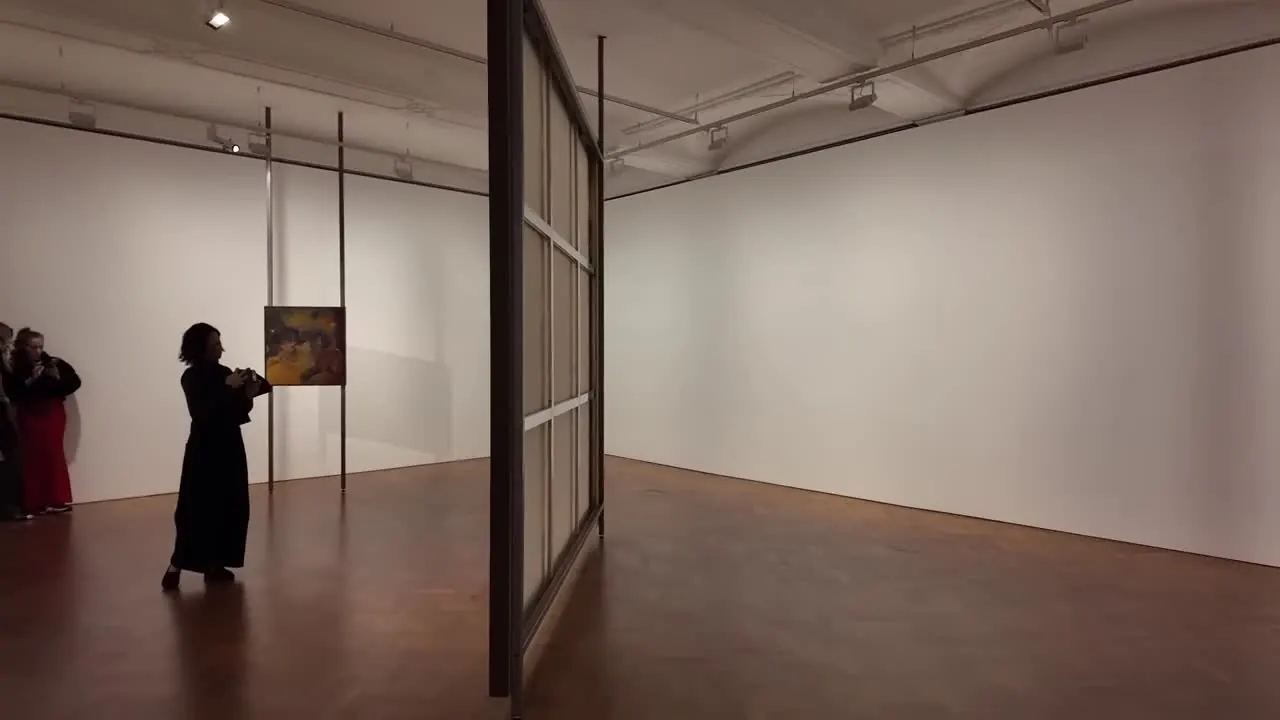
Eva Helene Pade’s “Søgelys” extends the question “What space do the figures occupy?” into “From what position am I looking at the painting?” Her paintings at Ropac are supported away from the walls on metal posts, leaving their backs and stretchers visible. The crowded bodies and smoke in the images thus interact with the routes viewers take between them. Moving around to the side reveals the stretcher behind a large painting, while in the stairwell, white classical mouldings stand alongside slender metal supports. Paintings also occupy landings and passageways. This gives painting both a front and a thickness that requires walking around it. I read this display as a choreography of looking: a change in position changes how paintings obscure one another and which ones appear alongside each other. The gatherings within the images are thus formed not only by the figures’ poses; they continue to develop through the relationships between canvases in the room. Thaddaeus Ropac exhibition text
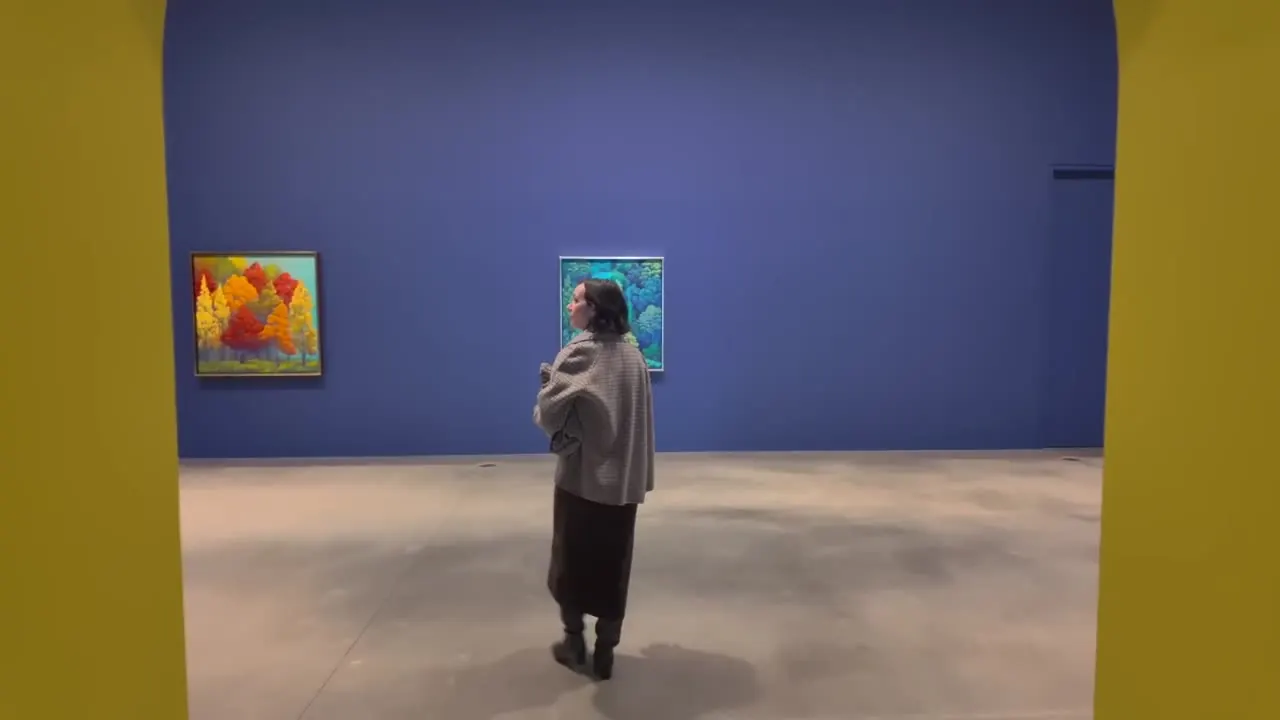
Nicolas Party’s “Clotho” at Hauser & Wirth exercises a different kind of control over the whole environment. Electric-blue walls and arches direct sightlines, placing pastel portraits and tree scenes within a continuous setting. Images of sculptures by Claudel and Rodin within the portraits set young faces against ageing forms. The bright yellow inside the arches is particularly clear: as the body passes through an opening, the view is first cropped by a yellow edge before entering the next blue room. These specific arrangements lead me to regard colour as part of the conditions of looking. The walls already participate in the works, and an arch adds another frame to a painting in the distance. Pade exposes the supporting structures and allows viewing positions to shift; Party uses architecture and colour to link images into a more controlled sequence. Hauser & Wirth exhibition text
Arthur Jafa’s “GLAS NEGUS SUPREME” at Sadie Coles HQ on Kingly Street entrusts the rhythm of looking to moving images, sound and editing, while also including paintings, screenprints and cut-outs. His use of collected and reconnected images to address Black life and representation makes me think about how the meaning of a fragment is often altered by the materials placed before and after it. In the gallery, similar performance imagery appears side by side in black, blue and red tones; elsewhere, there is a screen in a separate darkened room. I distinguish the juxtaposition in the bright main gallery from the screening in the darkened room that asks viewers to stay. Across its different media, the exhibition shifts attention between comparison and sustained viewing. Sadie Coles HQ exhibition text
Helen Marten’s “Treatise of a Coat” at Sadie Coles HQ on Bury Street is a separate presentation. Six wall-based works embed drawing within painting, and the cast-aluminium frames are also marked, allowing the part that usually defines a boundary to join the image. The garments, fur and coatings suggested by “coat” make covering both a material action and a clue for reading. A grey-white inner frame encloses a small yellow image, while around it spreads a complex plane of green, fine black lines and drips. I first trace how the inner and outer scales are set apart, then consider possible connections between the various signs. Placed alongside Jafa, I compare how the two organise fragments: Jafa’s editing makes relationships unfold in time, while Marten allows multiple layers of imagery to coexist, asking the eye to choose its own route. Sadie Coles HQ exhibition text
From Individual Works Back to Judging an Exhibition
This round of comparisons also makes me reconsider the different conditions for looking that galleries and art fairs can offer. An art fair makes it easier to bring different works together for quick recognition; a full solo exhibition has the opportunity to show how a method continues across different scales, media and rooms. For me, a more reliable judgment comes from asking one further question beyond the individual work: how much would its meaning change if the neighbouring work, wall colour, viewing distance or editing sequence were removed?
Hayden’s conflicts of function, Gomes’s bindings, Wool’s repeated reworkings, Ding Yi’s minute incisions and Pade’s and Party’s treatment of space all make this question concrete. These exhibitions make me more inclined to read a work within a whole room, observing how neighbouring works and spatial arrangements change its meaning.
Notes on the Index
Exhibition dates follow the current official records. Pade, Sundaram and Penone previously had different scheduled closing dates. Sources still disagree about the closing date for Ding Yi’s exhibition, so “Autumn 2025” is retained. Hugh Hayden’s official press release gives 26 September, while other listings give 27 September.
Exhibition and Artist Index
| Artist and exhibition | Gallery and video | Exhibition dates |
|---|---|---|
| Hugh Hayden Hughmanity | Lisson Gallery 27 Bell Street L1 00:40–06:20 | 2025.09.26–11.01 |
| Ding Yi The Road to Heaven | Lisson Gallery London L1 06:40–10:00 | Autumn 2025 |
| Christopher Wool Christopher Wool | Gagosian Grosvenor Hill L1 11:00–15:20 | 2025.10.13–12.19 |
| Eva Helene Pade Søgelys | Thaddaeus Ropac Ely House L1 16:00–24:20 | 2025.10.14–12.23 |
| Danielle Mckinney Second Wind | Galerie Max Hetzler 41 Dover Street L1 24:30–26:35 | 2025.09.18–11.01 |
| Sonia Gomes É preciso não ter medo de criar | Pace Gallery 5 Hanover Square L2 01:20–06:10 | 2025.10.14–11.15 |
| Alexandre Diop Run For Your Life ! | Stephen Friedman Gallery 5–6 Cork Street L2 06:45–11:45 | 2025.09.19–11.01 |
| Sagarika Sundaram Release | Alison Jacques 22 Cork Street L2 12:10–15:50 | 2025.10.14–12.13 |
| Lenz Geerk November | MASSIMODECARLO London L2 16:25–19:25 | 2025.10.13–11.15 |
| Sabine Moritz The Sleep of Tomorrow | Pilar Corrias 51 Conduit Street L2 19:45–24:20 | 2025.10.10–11.15 |
| Nicolas Party Clotho | Hauser & Wirth London L3 00:20–05:00 | 2025.10.14–12.20 |
| Manuel Mathieu Bury Your Masters | Pilar Corrias 2 Savile Row L3 05:20–08:00 | 2025.09.12–11.01 |
| Shaqúelle Whyte Winter Remembers April | Pippy Houldsworth Gallery London L3 08:10–10:40 | 2025.10.10–11.08 |
| Arthur Jafa GLAS NEGUS SUPREME | Sadie Coles HQ 62 Kingly Street L3 11:20–15:40 | 2025.10.10–12.20 |
| Dana Schutz One Big Animal | Thomas Dane Gallery 3 and 11 Duke Street L3 16:20–23:20 | 2025.10.14–12.20 |
| Helen Marten Treatise of a Coat | Sadie Coles HQ 8 Bury Street L3 23:25–25:20 | 2025.10.07–11.15 |
Sources and reference links 20
- Lisson Gallery exhibition notes
- Pace exhibition notes
- Alison Jacques exhibition and work information
- Stephen Friedman Gallery press release, archived by Artforum
- Gagosian exhibition notes
- Ding Yi Studio: exhibition information
- Pilar Corrias exhibition notes
- Pilar Corrias exhibition notes
- List of works
- Galerie Max Hetzler exhibition notes
- MASSIMODECARLO exhibition notes
- Pippy Houldsworth Gallery exhibition notes
- Thomas Dane Gallery exhibition and work information
- Thaddaeus Ropac exhibition notes
- Hauser & Wirth exhibition notes
- Sadie Coles HQ exhibition notes
- Sadie Coles HQ exhibition notes
- Thaddaeus Ropac
- Stephen Friedman Gallery
- Thomas Dane Gallery