ART YOU READY · EXHIBITION GUIDES · 02 / 06
Chelsea Galleries: Landscape, History and Viewing Distance
Spring 2026 · Seven exhibitions in Chelsea
From Penone’s bronze and Báez’s plant-bodies to the spaces inhabited by Mckinney’s and Yiadom-Boakye’s figures.
Looking back at these seven Chelsea exhibitions, I connect them through a question: when painting and sculpture preserve an experience of life, do they preserve an image, the traces of contact, or a relationship that has not yet been fully articulated? Landscape recurs, but performs different roles. It allows people who could never have met to inhabit a shared world, exposes the frameworks through which we look at nature, and becomes a place where colonial classification, bodily transformation and climate change collide. Even when figures appear quiet, they are not necessarily available for the viewer to explain.
A Shared Landscape Across Time
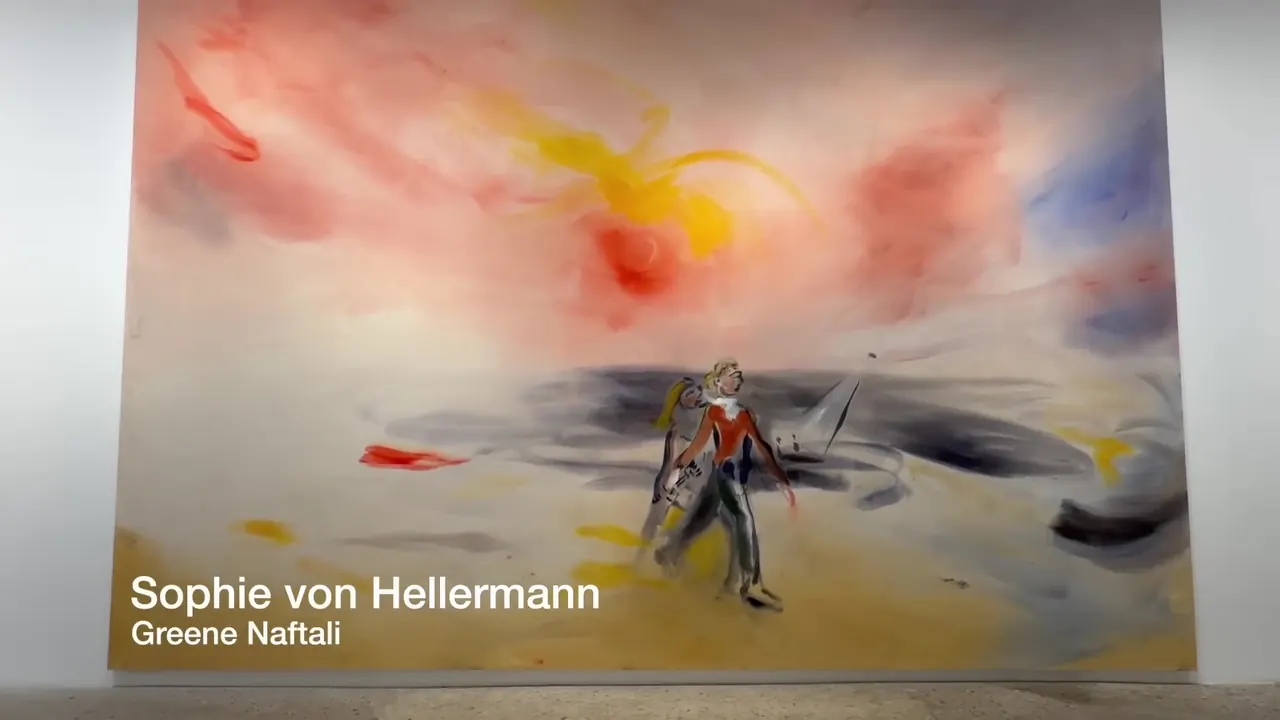
In Sophie von Hellermann’s After a Dream at Greene Naftali, I begin to think about relationships through what it means to appear together in one painting. Thin washes preserve the canvas’s brightness; two figures in a purple sky seem carried off the ground by the brushwork. In Silence, a pianist dressed in red leans forward, while the keys and radiating yellow light turn music into directional forces within the composition. Identity emerges less through finely described faces than through poses that face, connect with and drift toward one another. The large The sun rises over water (2025), measuring 4.1 by 6 metres, places the artist and Turner on the same shore, sharing a paintbrush. Greene Naftali: After a Dream I read this pairing across time as a form of creative intimacy: Turner becomes someone a contemporary painter can accompany and negotiate with, beyond simply being a name to cite. White walls, skylights and columns keep the paintings apart, while the immense seascape and smaller scenes of two people continually recalibrate one another’s scale. The dream consequently operates through two kinds of time: one resembles the movement of weather, the other a moment within a relationship. The official title Tschabalala’s Wedding also reminds me that these imaginings sometimes begin with specific social occasions; they cannot all be reduced to abstract romantic allegories.
The Different Times of Growth and Casting
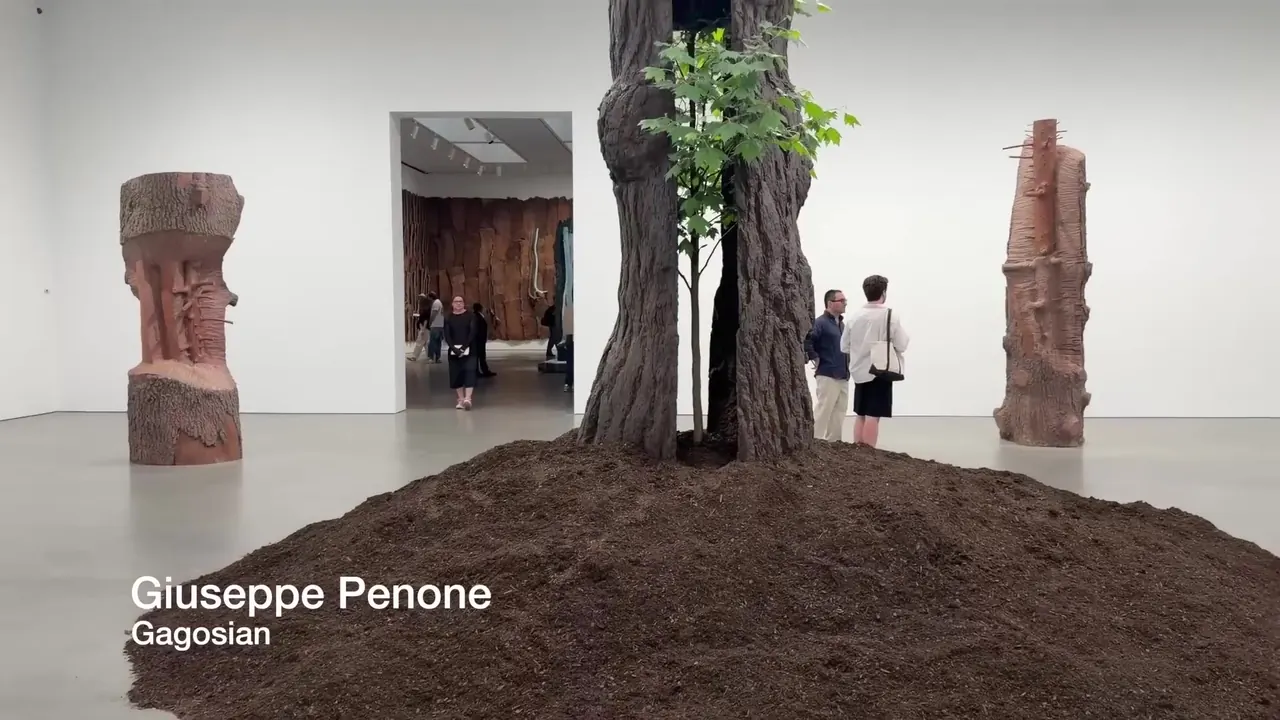
Giuseppe Penone’s The Reflection of Bronze at Gagosian turns contact into a material question. The tree-like Marsia (2024) juxtaposes brown and blue-green surfaces, with roots, suspended forms and a stone base exerting pressure on one another. The walls carry rough sheets of cork of uneven thickness. Official descriptions identify Marsia – cork (2025) as cork and bronze, while the central Marsia uses bronze, granite and stainless steel. Gagosian: The Reflection of Bronze This makes me attend to the differences in porosity, sheen and thickness between cork and metal within apparently similar brown surfaces. I am especially interested in the seams on the walls: the outer layer that once enclosed a tree has been spread out to enclose the viewer, turning the tree’s exterior scale into the room’s interior scale. Elsewhere, a raised earth surface appears at the centre; slender branches with green leaves grow among thick tree-like forms, while upright, section-like elements expose inner and outer textures. The display therefore cannot be understood as a forest of motionless specimens alone. Leaves retain the present time of growth, while cast surfaces preserve the dimensions of another moment, the two sharing the same ground. A further group of rectangular bronze panels, Riflesso del bronzo (2005), accumulates changes by using one panel to cast the next. Gagosian: The Reflection of Bronze Their regular arrangement makes differences easier to compare. Durability here makes transfer, loss and reproduction visible as time, rather than simply stopping growth and sealing it away.
How an Interior Encloses a Figure
Danielle Mckinney’s Forest for the Trees compresses the same relationship between inside and outside into a domestic room. In one oil painting, a warm circular lamp, large red-pink floral shapes and dark furniture create a dense enclosure, with a reclining woman partly merging into cushions and shadow. By contrast, a seated body in a watercolour hangs within a broad field of white paper, its extended leg making a clear horizontal line. Without furniture to establish location, the paper itself carries the space. Grey-green gallery walls and the white frames around the watercolours add further layers between the external setting and the blank areas within the images. Across the continuous exhibition space, green walls turn several corners; small paintings are widely spaced, with pools of light above each work. The room thus resembles an enlarged interior painting: the viewer is first enclosed by dark walls, then approaches another, more private interior. This arrangement supports close comparisons of dispersed and concentrated pigment without using immense scale to create immersion. The gallery states that the exhibition includes ten oil paintings and a group of watercolours, with figures handled more loosely and interiors becoming more assertive. Boesky Gallery: Forest for the Trees I am therefore reluctant to read rest as evidence that healing has already occurred. Might a room protect its occupants while also limiting their movement? A blurred bodily boundary can suggest relaxation, but also uncertainty about one’s distance from the world. The women in these different images are each alone, forming a set of interior experiences that echo one another.
Historical Landscapes and Constructed Frames
Whitney Bedford’s self-titled exhibition at Miles McEnery makes the boundary between interior and landscape more explicit. In the Veduta series, neon lines, plant silhouettes and window-like rectangles are layered over historical landscapes. In one painting, blue and orange tree forms flank a red sun above an orange-red sea; in another, pink-white hanging branches seem cut out and pasted over the sunset. Tonal gradation gives the distance depth, while foreground contours pull the eye back to the surface. The gallery identifies these works as ink and oil on nylinen mounted on panel and cites the experience of Southern California wildfires as part of their context. Miles McEnery: Whitney Bedford I do not equate every red mark directly with flame. Instead, I see the brilliant colour as a warning within the act of looking: the landscape remains seductive, but its constructed frames unsettle the reassuring idea that nature is simply outside the window. The gallery spaces similarly sized works along a long white wall, while the street outside also enters the field of vision, establishing an exchange between the windows within the paintings and actual architectural openings. Compared with von Hellermann’s figures sharing a landscape, Bedford places greater emphasis on the fact that we already see nature through art history and architecture.
Bodies and Plants Within Systems of Classification
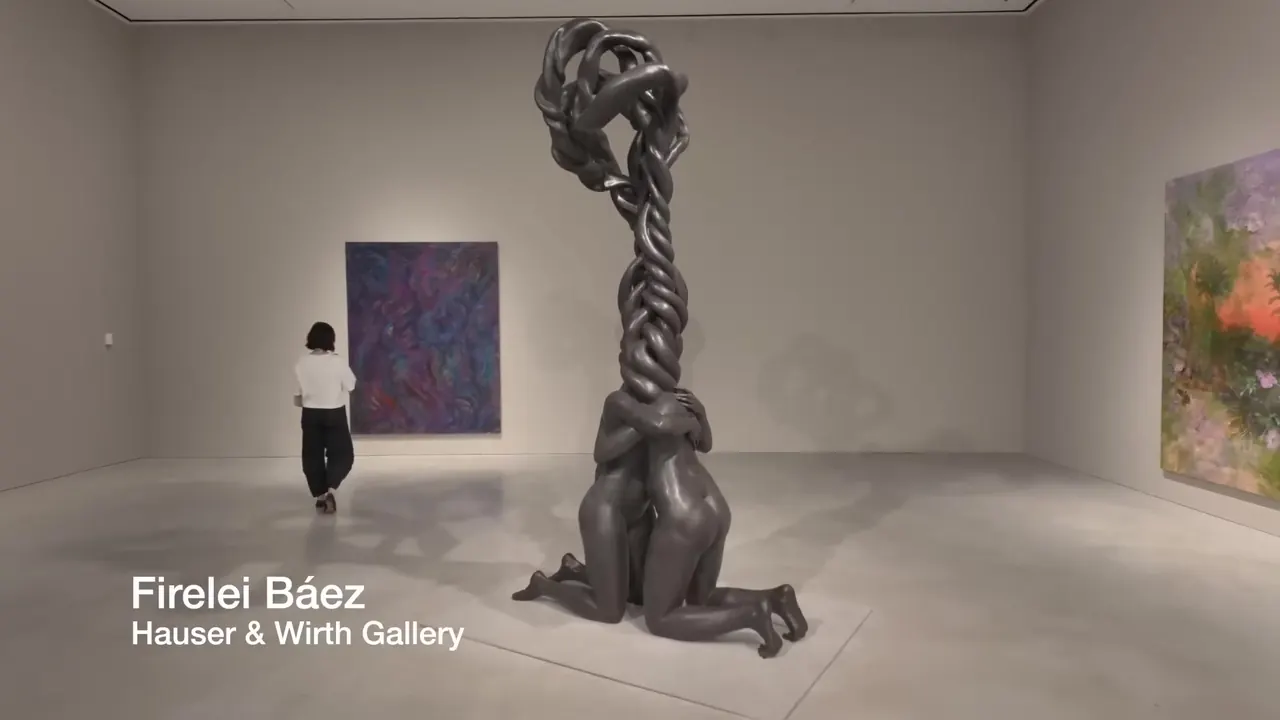
Firelei Báez’s feet squelching on wet grass, nourished by uncertainty extends the question of landscape’s frames into knowledge and power. The eight-panel View of Nature (2026) takes John Emslie’s 1852 print of the same title as its basis, bringing the classification of climates from the equator to the Arctic into painting. Hauser & Wirth: Firelei Báez At a distance, the work forms an extended transition from warm colour and dense foliage to icy blue and pale white; up close, text, diagrams and plant forms obscure one another. “SINGAPORE” remains legible in one area, but flowers and layered leaves grow around the place name, disturbing the clarity of classification. The same logic affects the body: long leaves cover a reclining form before an architectural drawing, while flowers and fruit proliferate from the upper body of a purple crouching figure. These images and the bronze sculpture in the gallery keep the relationship between people and plants at the exhibition’s centre. I understand the body as becoming harder to separate from vegetation, rather than disappearing. The bronze form twists upward into a long braid-like knot while retaining kneeling legs below; the plant-like extension remains connected to bodily weight. Its vertical movement sets up another comparison of scale with the horizontal expansion of the eight-panel painting: one unfolds geography, while the other concentrates transformation in a single body. The long wall demands sideways movement; the sculpture brings attention back to where the viewer stands. A geographic panorama becomes an environment that must be measured through the body.
Disguised Materials and Unfinished Forms
Mark Manders’s sculptures at Tanya Bonakdar make me reconsider the gap between what something resembles and what it is made of. The bone-white surface of a large head is covered in fissures; smaller heads and torsos have broken, rough edges. Yet the material that appears to be unfired clay, capable of crumbling at any moment, is painted bronze. Monument (2024–2025) attaches a mass to the throat. Tanya Bonakdar: Mark Manders I associate it with obstructed speech, while retaining its direct effect as weight and irregular volume: the viewer must move to the side to understand the tensions between head, neck and protrusion. Large works, freestanding plinths and small constructions in glass cases alternate, as if the exhibition were shifting between public monuments and private models. Above the sandy ground of the small Field Fragment, a few thin blue pieces join into a suspended line; the immensity of the sky contracts into a balance that a tiny weight could change. The artist-made newspaper All Existing Words turns text into a three-dimensional framing material. Tanya Bonakdar: Mark Manders Penone’s bronze makes the surface record transformation; Manders’s bronze creates a state of seeming incompletion. Both make permanence something that cannot be measured by hardness alone.
Fictional Figures and Viewing Distance
Finally, Lynette Yiadom-Boakye’s Many A Moonlit Caveat returns me to whether figures owe viewers an explanation of themselves. In From High Tea’s End to Revolution (2026), a white tablecloth fills most of the image. Teacups, plates and cakes create circular rhythms, while figures enter from the upper edge and the left; the relationships at the table do not resolve into a single definite event. Pieces of Work (2026), in charcoal on paper, arranges three figures: the central figure raises both hands to the head, the body on the left faces a companion, and the figure on the right bends forward. Jack Shainman: Many A Moonlit Caveat The blank areas make the distances between gestures important. The Diligent Crest of Midday (2026) establishes a room through a blue-and-white chequered floor, door frames and a wall clock: the positions of the two people are clear, while their relationship remains open. These fictional figures do not need identifiable biographies to possess the weight of existence. Jack Shainman: Lynette Yiadom-Boakye Dispersed hanging on white walls gives each painting its own space of encounter. The movement between oils and works on paper also shifts looking between the thickness of colour and the energy of lines. I read the birds’ refusal to talk, eat or be touched in the poem sharing the exhibition’s title as a suggestion of boundaries to looking, rather than a code for solving every figure. Jack Shainman: Many A Moonlit Caveat
Connecting the seven exhibitions makes me more attentive to how artists balance what can be recognised with what cannot be fully grasped. Von Hellermann brings historical figures into new relationships; Bedford and Báez dismantle the visual frames and classificatory structures of landscape respectively; Mckinney and Yiadom-Boakye allow figures room not to respond to the viewer; Penone and Manders use material surfaces to disturb our judgments of time. When organising my visit notes, I therefore distinguish visual evidence, official information and personal interpretation. Leaving a gap where detail is insufficient often comes closer to a work’s force than supplying a complete story.
Notes on the Index
Veduta is the name of Whitney Bedford’s series. Báez’s exhibition occupied two floors; the video’s author states that she recorded only one. Yiadom-Boakye showed concurrently in Chelsea and Tribeca; this report analyses the Chelsea segment.
Exhibition and Artist Index
| Artist and exhibition | Gallery and video | Exhibition dates |
|---|---|---|
| Sophie von Hellermann After a Dream | Greene Naftali C 00:00–05:31 | 2026.04.30–06.20 |
| Giuseppe Penone The Reflection of Bronze | Gagosian C 05:31–07:07 | 2026.04.22–07.17 |
| Danielle Mckinney Forest for the Trees | Boesky Gallery C 07:07–09:52 | 2026.05.07–06.13 |
| Whitney Bedford Whitney Bedford | Miles McEnery Gallery C 09:52–12:29 | 2026.05.14–06.20 |
| Firelei Báez feet squelching on wet grass, nourished by uncertainty | Hauser & Wirth C 12:29–17:12 | 2026.05.12–07.31 |
| Mark Manders Mark Manders | Tanya Bonakdar Gallery C 17:12–21:34 | 2026.04.30–07.31 |
| Lynette Yiadom-Boakye Many A Moonlit Caveat | Jack Shainman Gallery C 21:34–24:48 | 2026.04.24–07.31 |