Roy Lichtenstein’s Market Is on Fire. Here Comes a Whitney Show With Mega Loans
Billionaires Ken Griffin and Steve Cohen are sending masterpieces to New York, after the Pop artist's biggest auction year in a decade.
Original author · Katya Kazakina
Artnet News / Artnet Pro ·
Reading & commentary · Art Value Lab
Original reading · 01
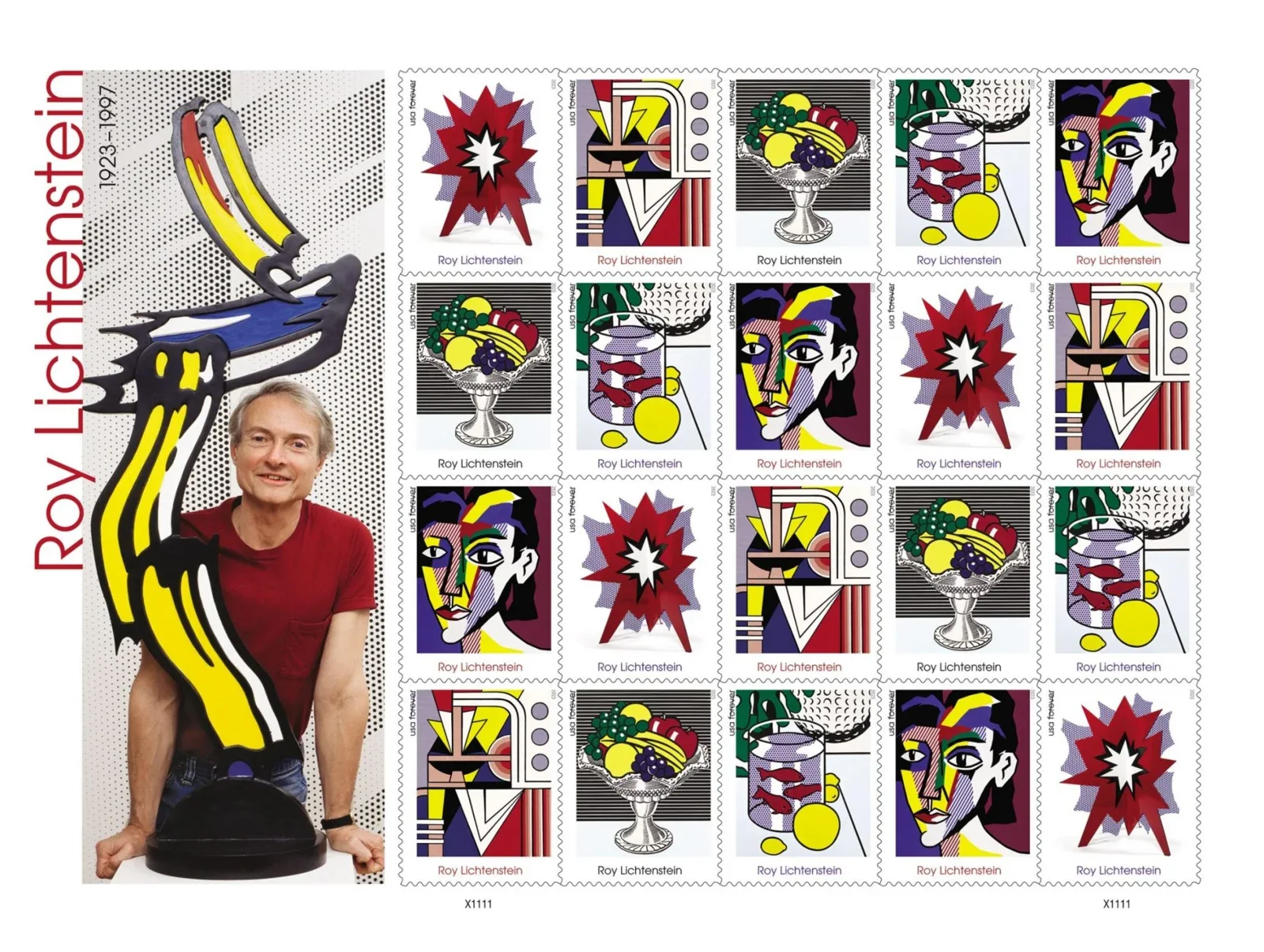
This week, the Whitney Museum of American Art sent out an email detailing its long-awaited Roy Lichtenstein exhibition, which will finally open to the public on October 11. The show was originally scheduled for 2023, as part of centennial celebrations of the Pop artist’s birth that included the U.S. Postal Service issuing “Forever” stamps with five of his paintings. The stamps came out. The exhibition got delayed.
In the meantime, Dorothy Lichtenstein , the artist’s widow and president of the Roy Lichtenstein Foundation , died in 2024 at the age of 84. The couple’s two sons sent scores of their father’s works to auction. “They have estate taxes to pay,” said Jack Cowart , the foundation’s executive director, adding that the non-profit had nothing to do with the sales.
The timing seemed precarious. The art market was in the middle of a prolonged contraction, and Lichtenstein’s auction results were just recovering from their deepest slump since the financial crisis in 2009. Releasing hundreds of additional works—from blue-chip paintings to prints, drawings, and sketches—risked overwhelming buyers.
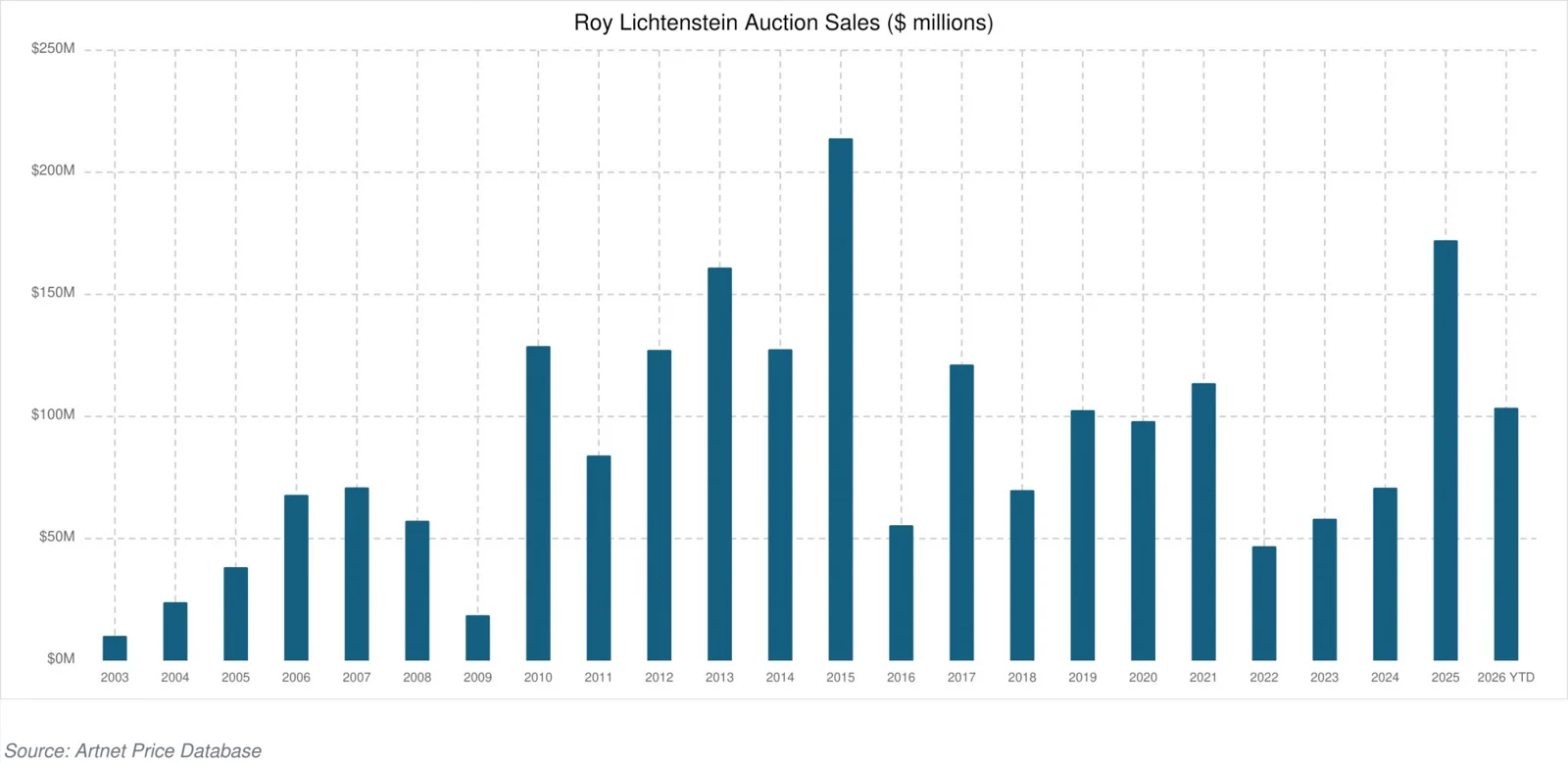
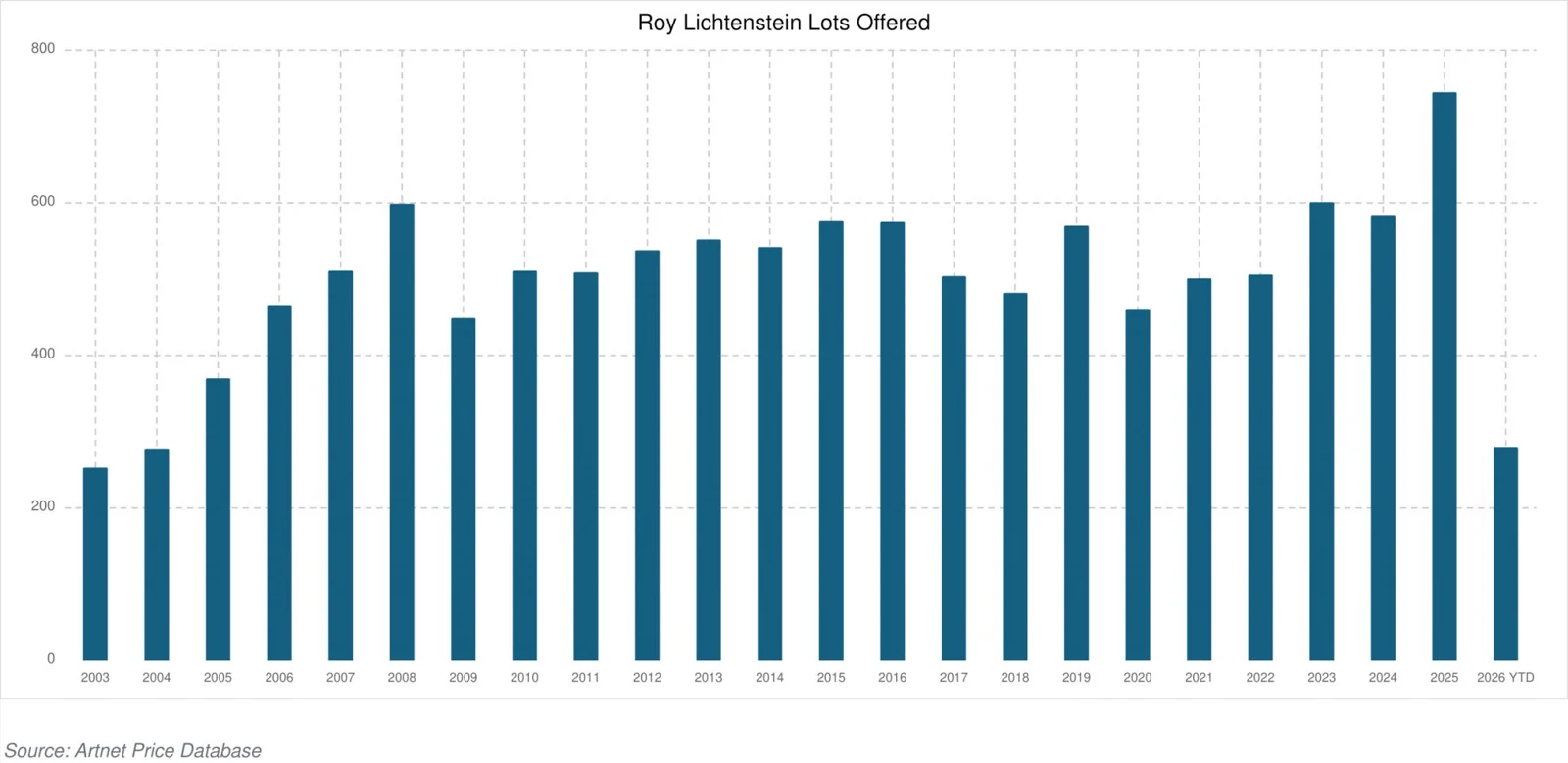
Instead, “A Legacy Reimagined: Works from the Collection of Dorothy and Roy Lichtenstein” had the opposite effect. Even as the number of Lichtenstein works coming to auction hit a new record in 2025, his annual sales on the block quadrupled from three years earlier, to $172 million, and the average price per lot nearly doubled, according to the Artnet Price Database .
The next round of bellwether New York auctions in November will arrive just a month after the opening of “Roy Lichtenstein: Like New” at the Whitney. Organized by Meg Onli , a curator at the Whitney, and artist Alex Da Corte, who are both in their 40s, it will unite about 130 works spanning five decades.
Auction houses no doubt will scour the Whitney show for fresh consignments. (Let’s hope that the paintings don’t get yanked from the Renzo Piano –designed walls for sale. This has happened!)
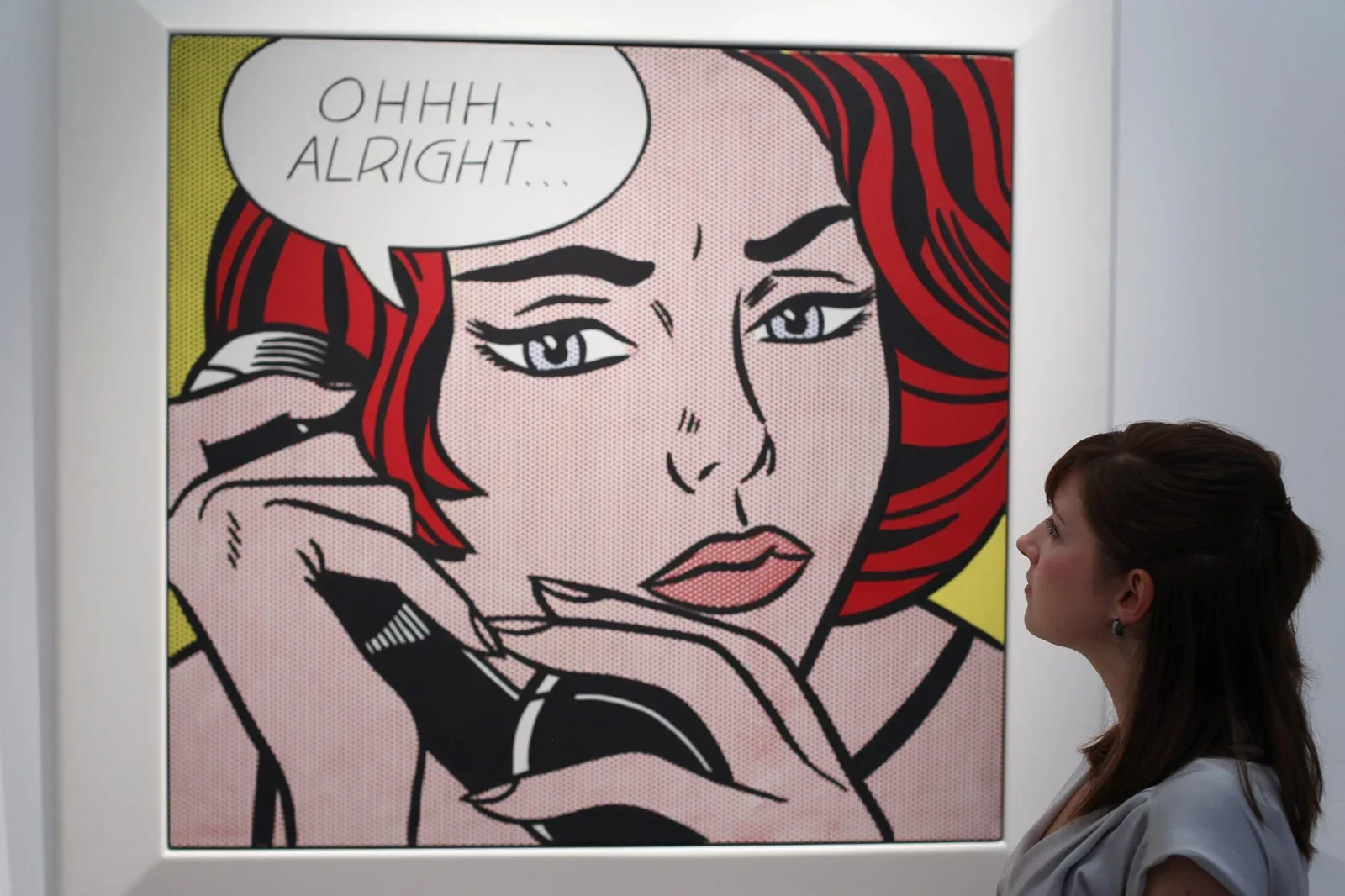
I obtained an uncorrected proof of the exhibition catalogue from the museum and discovered some clues on whose doors auction specialists may soon knock. Among the loans from major museums and anonymous private collectors, one name stands out: billionaire hedge fund manager Ken Griffin . The catalogue identifies him as the owner of Ohhh . . . Alright . . . , a 1964 painting that last appeared at auction in 2010, fetching $42.6 million at Christie’s . Griffin is also loaning a related drawing with the same title.
Other potential targets: A knockout 1961 painting, The Engagement Ring , will be sent to the show by collector Ronnie F. Heyman , president emerita of the Museum of Modern Art . Newsprint mogul Peter M. Brant , who sold a few Lichtensteins in recent seasons, is the owner of The Refrigerator , a 1962 painting he appears to have had since the 1980s, according to the artist’s catalogue raisonné. Miami- based collector Martin Margulies , who has also been a seller recently, loaned a Picasso -inspired 1962 painting, Femme au chapeau .
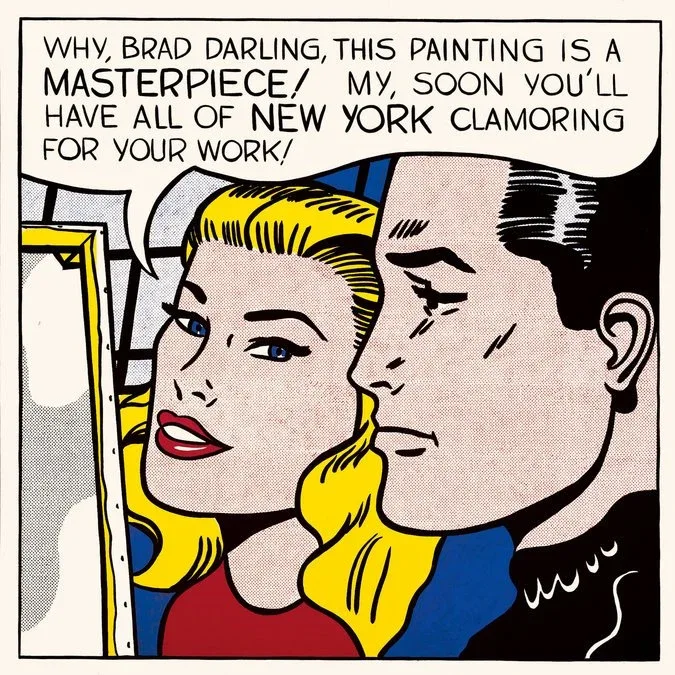
And of course, there’s Masterpiece , a 1962 painting featuring Lichtenstein’s signature Ben-Day dots, a text bubble, and a handsome couple. Steve Cohen , the billionaire financier and Mets owner, paid $165 million for Agnes Gund ‘s trophy painting in a private transaction in 2017, the highest known price for the artist. The catalogue raisonné still lists him as the owner, while the Whitney’s describes the lender as a “private collection.”
Original reading · 02
Market Recovery
The auction totals for top 20th-century artists like Jackson Pollock , Mark Rothko , and Andy Warhol often swing dramatically from year to year, as one or two major pictures come to the auction block (or don’t).
Lichtenstein, who is usually mentioned in the same breath as Warhol as a father of Pop Art in the 1960s, is no exception.
In 2015, his Nurse (1964) sold for $95 million at Christie’s, an auction record, contributing to total auction sales of $214 million that year, according to Artnet Price Database. (That’s about $302 million, adjusting for inflation.) The following year, his auction revenue fell by about 75 percent, with the top lot going for just $21 million.
It took a decade for Lichtenstein’s auction market to recover. In 2022, the artist ranked 54th on Artnet’s list of the top 500 artists, with annual auction sales of $46.9 million.
In 2025, he shot up to sixth, with $172.2 million in annual sales, the highest total for him since 2015.
But there are significant differences between these two peaks.
The priciest work in 2025 was just $5.49 million—for a drawing, The Kiss (1962) sold anonymously by Brant at Christie’s—a tiny fraction of the $95 million top result in 2015.
Last year was also exceptional because of the record number of Lichtenstein lots on offer: 745, to be precise. Historically, that figure has fluctuated between 500 and 600, according to Artnet data.
Another intriguing data point: His top 10 lots last year accounted for a quarter of total annual sales, a historical anomaly. Typically, the top 10 lots account for most of the total.
Original reading · 03
And as I mentioned, the average lot price nearly doubled, from $145,712 in 2024 to $263,255 in 2025.
That trend has continued into this year: Artnet data shows that the average lot price has nearly doubled again—to $436,913!—just shy of the all-time high average price of $443,848 in 2015.
Shrewd Strategy
Sotheby’s began selling works from Dorothy Lichtenstein’s estate in November 2024, offering six lots in an evening sale better remembered for Maurizio Cattelan ‘s taped banana selling for $6 million. Five lots exceeded their presale high estimates, setting the tone for the rest of the trove when it later came to market.
“They didn’t give much information on how much there was and what else was coming,” art advisor Hugo Nathan said of Sotheby’s approach. “It was handled very shrewdly.”
Over the ensuing 18 months, Sotheby’s offered 266 Lichtenstein lots and sold 263 of them, an astonishing 99 percent sell-through rate. The objects generated $175.6 million, exceeding the high estimate of $148.1 million, according to a spokesperson. (Final prices include fees; estimates don’t.)
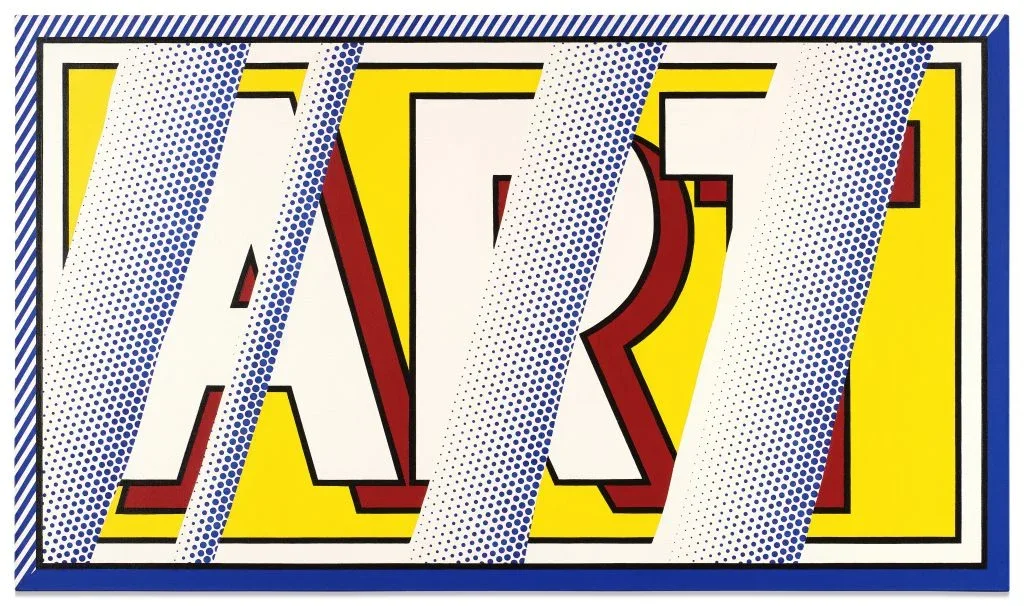
The house devised four dedicated auctions and included the rest in 16 various owner sales from November 2024 to this past May. Bidders from 38 countries competed, according to Sotheby’s. Some works fetched many times their estimates. The top lot was a 1988 painting, Reflections: Art, that made $5.48 million, squarely within the estimated range of $4 million to $6 million.
The competitive dynamic at every price point reflected a “robust, dynamic, engaged market,” David Galperin , Sotheby’s head of contemporary art in New York, told me this week, mentioning “the competition for prints that are $100,000. The competition for collages that are $800,000. The competition for sculptures that are $2 million.”
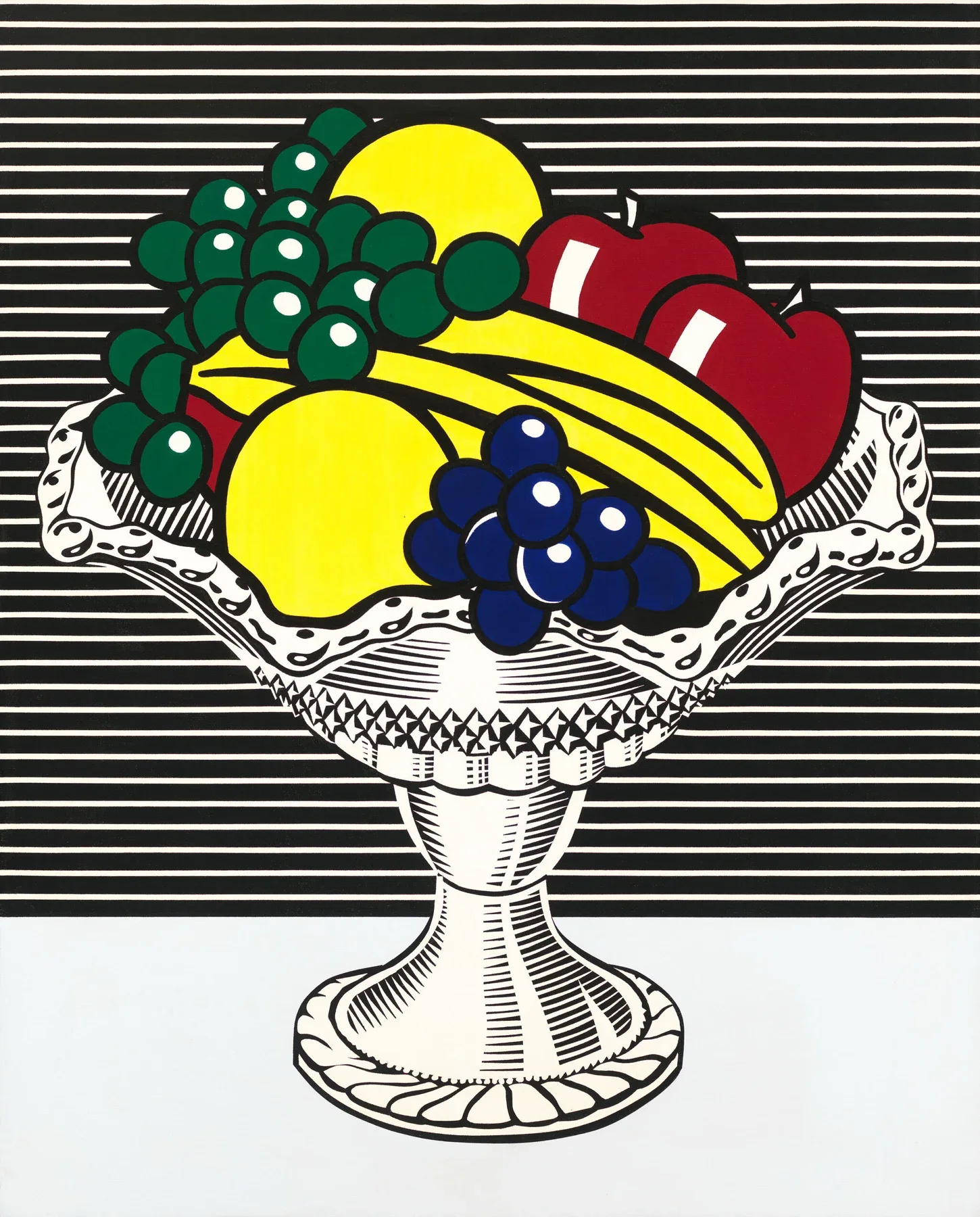
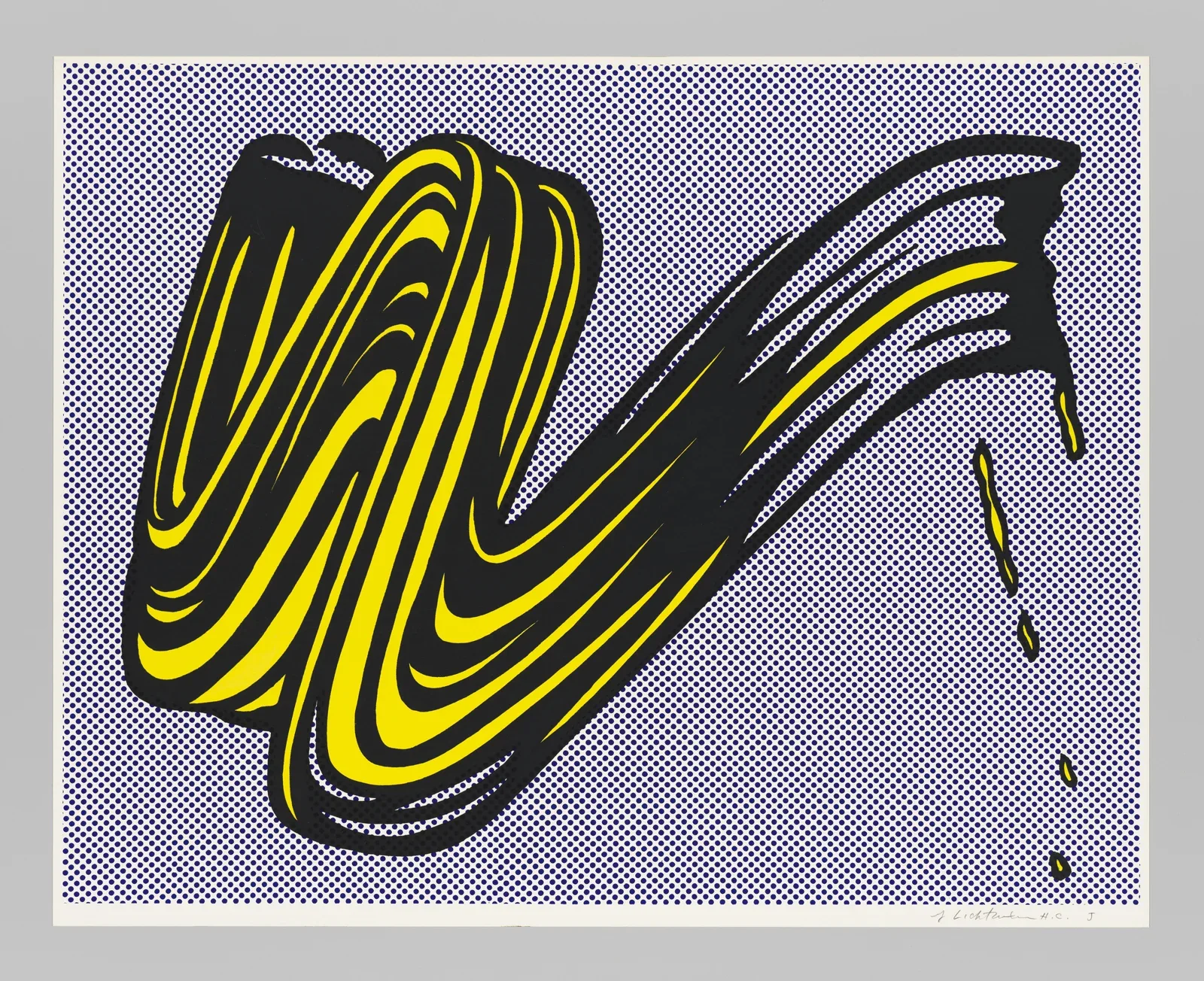
A limited-edition print, The Gun in America (1989), estimated at $20,000 to $30,000, sold for $342,000. A lithograph, Sunrise (1965), estimated at $8,000 to $12,000, went for $114,300. A 1988 painting, Reflections: Wimpy I , sold for $2.86 million, well above its $1 million- to-$1.5 million estimate.
Top advisors like Nathan and Jussi Pylkkänen bid and bought many works for their clients.
Original reading · 04
“I am trying to think if any of our clients don’t own a Lichtenstein,” said Nathan, whose advisory firm Beaumont Nathan is credited in the Whitney catalog as the lender of Mirror #12 (1970) on behalf of a private collection. “Nearly all of them do.”
Pylkkänen said that some of the world’s top collectors bought groups of six or seven works from various Roy and Dorothy Lichtenstein sales.
“He never got boring,” Pylkkänen said of Lichtenstein. “He constantly was developing new theories of how exciting compositions could be built with very simple language.”
Advisors and dealers credited Sotheby’s not only for splitting the estate into several sales but also for keeping the estimates conservative. The combination of fresh material and exceptional condition proved irresistible, inspiring buyers to come back to bid again and again.
“It showed the depth of that market,” said Pylkkänen.
But elsewhere, the results for Lichtenstein’s works were mixed. At Christie’s in May, a 1964 painting Anxious Girl was estimated at $60 million, but hammered at $39.5 million ($46 million after fees). The Kiss , which was the top Lichtenstein lot of 2025 at $5.49 million, had been estimated at $7 million to $9 million.
The big question now is: Was the demand of the past two years unique to the Dorothy Lichtenstein estate, or will it endure?
Read the argument alongside market data
Source & reading notes
Roy Lichtenstein’s Market Is on Fire. Here Comes a Whitney Show With Mega Loans
Katya Kazakina · Artnet News · 2026-07-24
The English reading retains the supplied article’s wording, with navigation, advertising and recommendations removed. The Chinese edition is an editorial guide, not a parallel translation. Observations refer to the publication date. Art Value Lab commentary does not represent the author’s views. Image rights remain with their respective owners.