Singapore to Doha to Delhi? The New Cultural Corridor Shaping Asia’s Art Market
As India rises, some of its art patrons are settling in Singapore—and all eyes are on Qatar.
Original author · Vivienne Chow
Artnet News / Artnet Pro ·
Reading & commentary · Art Value Lab
The article
This year’s Art SG , which closed last month, featured an intriguing debut: South Asian Insights , a modest pavilion dedicated to contemporary art from the region. Part of the TVS Initiative for Indian and South Asian Contemporary Art , it was backed by India’s TVS Motor Company , one of the world’s largest two-wheel manufacturers, which has its global headquarters in Singapore. Eight galleries—five from India—were each given a wall to showcase art.
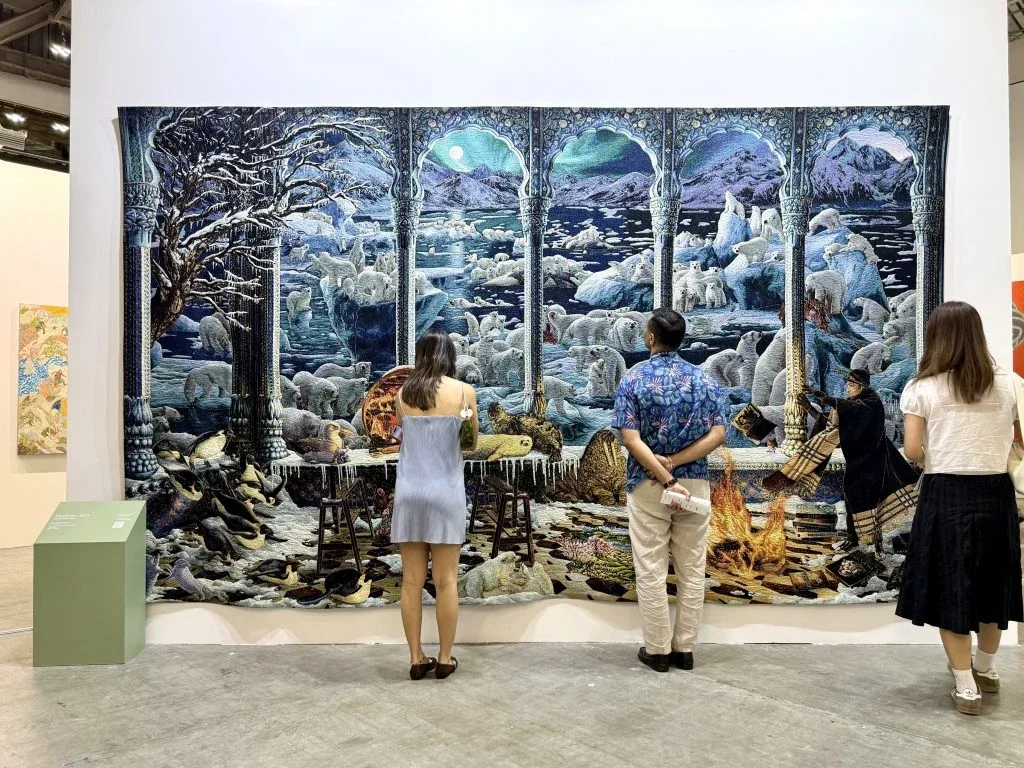
In the middle was a tapestry work by the Indian-born, London-based artist Raqib Shaw , which was presented by White Cube and acquired by the Japanese collector Kankuro Ueshima (who was interviewed by The Asia Pivot in 2024) for £275,000 (about $377,000).
South Asian Insights was, in part, an attempt in capitalize on the recent rise of South Asian art, especially Indian art. But this popular project, which was jam-packed when I visited, may also help Singapore to better position itself on the global art stage.
For years, the city-state has been trying to establish itself as an art capital—as a kind of rival to Hong Kong or as a hub for Southeast Asia. But although Singapore has immense wealth and no lack of dedicated galleries and artists whose work resonates with globe currents, it has still felt like something was missing. Could a close link with India become a core part of its identity?
While the flow of Chinese wealth into the city has cooled over the last year, high-net-worth individuals from India have been entering, and some are heavily involved in the arts, Chennai-based collector Jaiveer Johal told me in a recent interview . Some examples: Shruti and Vikram Hora and HCLTech , an Indian tech company, are notable patrons of the National Gallery Singapore .
Although not every gallery taking part in South Asian Insights made sales, their presence provided connections with important Indian collectors based in Singapore, starting conversations that may continue this week in Doha and New Delhi, at the inaugural Art Basel Qatar (which has 87 galleries) and the India Art Fair (123 exhibitors). Their VIP days are scheduled to allow collectors to attend both, hitting Doha first, then Delhi.
Singapore will continue to be a meeting point for collectors and industry players from across Southeast Asia, and in the coming years, it’s possible that we will see the development of a cultural corridor connecting Singapore, Doha, and New Delhi that comes alive in the first quarter, leading into the continent’s key annual event, Art Basel Hong Kong , at the end of March.
Another new initiative debuted in Singapore this year: the STPI Print Show and Symposium , a multi-pronged celebration of that medium. It was the first time that STPI staged an exhibition at the gallery’s premises with works offered by other dealers.
While discussing the upward trend for prints across the globe with Molly Steiger (from Sotheby’s ), Mazdak Sanii ( Avant Arte ), and Jenny Gibbs ( IFPDA Print Fair ) on the panel I moderated, I was reminded of just how far behind Asia is compared to Europe and North America in terms of total auction sales in the category. There currently isn’t a print fair in Asia. Could one start? STPI’s Print Show may lead to something bigger in the future. This week will see the launch of Art Jakarta Papers (February 5–8) in Indonesia, a new fair featuring 28 galleries from across Asia dedicated to works on paper, a medium that has long been overlooked in the region. A new trend is brewing in this part of the world.
For Singapore to succeed on the international stage, it needs to have unique offerings, rather than just trying to replicate what’s already out there. Last month, I saw some promising signs. Now let’s see if that momentum builds in Doha and New Delhi.
Read the argument alongside market data
Source & reading notes
Singapore to Doha to Delhi? The New Cultural Corridor Shaping Asia’s Art Market
Vivienne Chow · Artnet News · 2026-02-02
The English reading retains the supplied article’s wording, with navigation, advertising and recommendations removed. The Chinese edition is an editorial guide, not a parallel translation. Observations refer to the publication date. Art Value Lab commentary does not represent the author’s views. Image rights remain with their respective owners.