ART YOU READY · EXHIBITION GUIDES · 03 / 06
NADA New York 2026: Images, Objects and Booths
13–17 May 2026 · Starrett-Lehigh Building
Across twenty booths, a comparison of transformed images, stand-ins for bodies, small objects and shared displays.
NADA New York 2026 took place from 13 to 17 May at the Starrett-Lehigh Building. This chapter follows the relationships between images, objects and booth spaces through selected presentations by twenty galleries. NADA 2026 official information
How Images Reorganise Space
Looking back through my NADA visit materials, I focus on how works change the distance from which we look. White partition walls, continuous aisles and exposed ceiling services often bring work from different booths into view at once. Yet a first glance from the aisle differs from the understanding that comes after examining a surface closely. I therefore begin with the image, then follow how it extends into objects, bodies and the arrangement of a whole booth.
The two artists at Plato Gallery offer a clear starting point. Erik Nieminen crowds limbs resembling classical statuary, drapery and plants into a single horizontal composition. Grey-white, cool-blue and ochre bodies interweave: they remain recognisable, yet are difficult to disentangle. Alex Sutcliffe’s forest scenes are broken apart by rotating, interlacing brushstrokes. Branches and leaves remain, but space is no longer stable. I look at the two together: one accumulates clearly described forms; the other lets forms shift within brushwork. Both prevent attention from settling on a single focus. At Mrs., Kate Barbee places figures in interiors dominated by pink and yellow, filled with pictures-within-pictures and compartmentalised objects. Bodies and displayed objects build a world of nested layers.
At RAINRAIN, Kosuke Kawahara’s vertical paintings place pink face-like fragments, suggestions of hands, everyday vessels, dot patterns and fluorescent-yellow lines against grey-white backgrounds. A more sparsely worked pale yellow-green painting nearby makes a human-like outline seem about to dissolve just after appearing. Compared with the works at Plato, the distinction concerns how much integrity an image allows a form to retain, beyond simply whether it is figurative or abstract. I therefore leave ambiguity in my notes instead of assigning a story to every fragment.
Bodies Can Be Fragmented or Replaced by Clothing
Moving from painting toward the body, I encounter several different figurative languages. Molly Lowe at Marinaro pushes faces and flesh-like fragments into compression, curls and cropping. Eyes, noses and mouths remain identifiable, but no longer form stable portraits. Esaí Alfredo at Spinello Projects retains clear figures, using turquoise, magenta and deep-blue light to divide skin and clothing. A back view, a man looking over his shoulder, cars and distant mountain ridges suggest a moment within a story, but the work does not supply its complete plot.
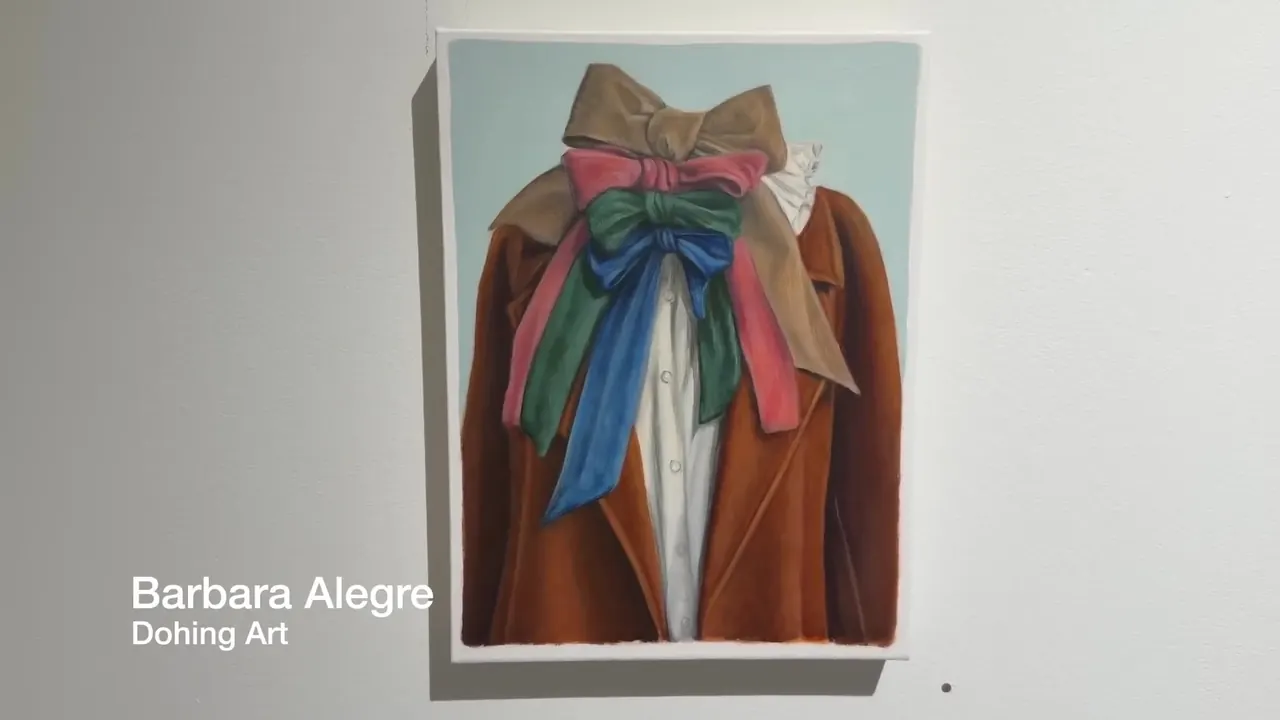
Bárbara Alegre at Dohing Art allows clothing to occupy the figure’s place. Four layers of coloured bows sit over a brown jacket and white shirt; another painting centres on purple gloves and a white pleated bodice, without showing a face. My comparison asks how a body can still be felt when facial information is reduced. Jisook Jung at Playlist offers a three-dimensional response. A golden-yellow, round-headed character has only tiny eyes and a nose; a purple character with dangling legs has a densely granular upper body surrounding a smooth circular area. Expression is established through proportion, posture and differences in surface rather than naturalistic detail.
Small Objects and Their Supports
Leif Low-Beer at L.L. Contemporary arranges faces, shoe-like forms, slender figures and geometric combinations on long shelves and platforms, echoed by grids, thin strips and blocks of colour on the wall. I understand the booth as a set of object relationships that need to be identified individually, then reconnected. The scale is small, but a single glance cannot take it all in. Ryan Browning at ADA Gallery likewise moves between scales. Eight small paintings in deep frames form two rows, simplified linear shapes enclosed by silver-grey surrounds. Another small painting occupies the centre of a larger frame; a row of white blocks below makes the frame resemble a miniature space. A white branching form and an orange-red star against pink turn patterns into reliefs that cast shadows.
Eunoia juxtaposes paintings by Ryoko Furukawa with ceramics by Yuka Nishihisamatsu. Furukawa develops her paintings through cut-up and recombined text. Nishihisamatsu’s Temporary Room forms an upright volume with an elongated conical top and circular opening at its base; Rebirth sends long horns in different directions; Body of thread grows thin, red-tipped tubes from a pale vessel. Comparing the three ceramics with the indistinct forms on the wall, I find that the crucial viewing condition is the constantly changing height between floor, shelf and wall. At Mrs., Susan Classen Sullivan’s white tree-like sculpture connects an open network of ribs below to a branching canopy above. Across these works, I compare how forms use voids, supports, shadows and height to carry looking beyond the rectangular image. Eunoia’s official works and fair record
A Shared Scene Within the Booth
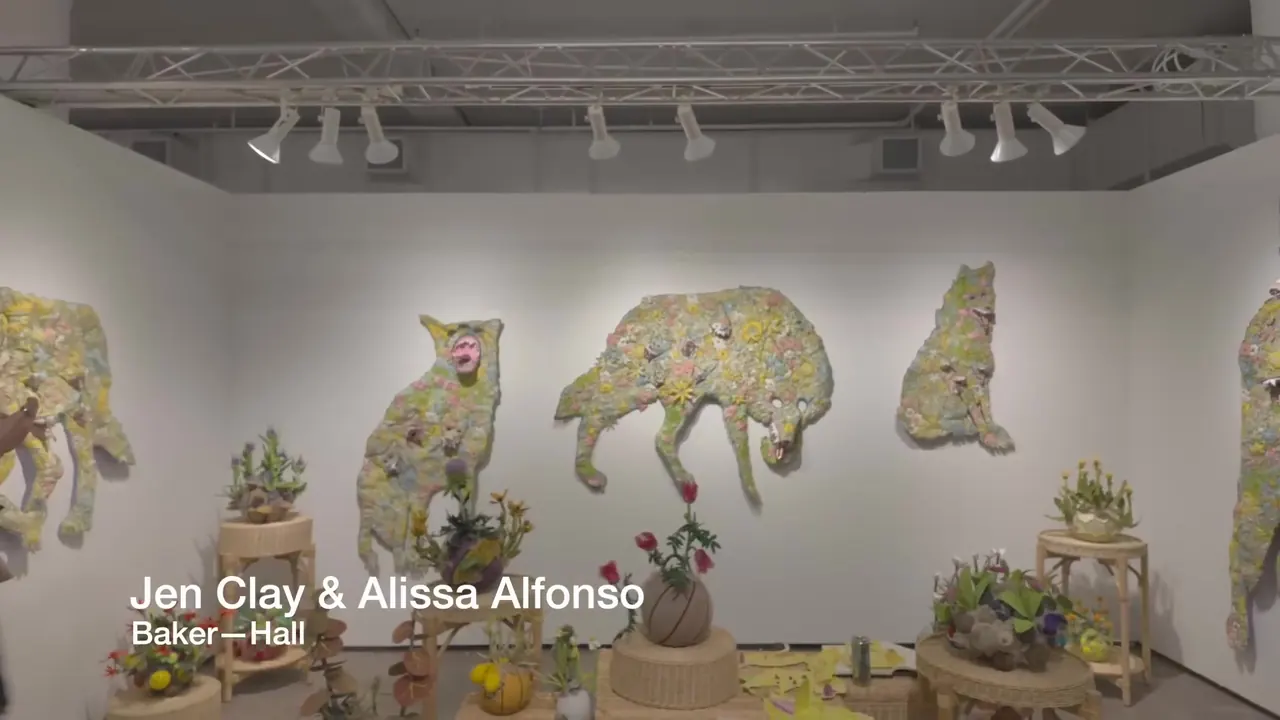
Baker—Hall is a key example in my consideration of overall display. Jen Clay’s large animal and monster silhouettes hang on the wall, densely patterned with flowers yet interrupted by pink-purple open mouths, sharp teeth and multiple oral forms. Alissa Alfonso’s vases and plant-like objects occupy wicker tables and stools of different heights, extending through the middle of the booth and onto the floor. The wicker furniture supports the works, enabling the two artists’ distinct objects to establish relationships within one field of vision. Baker—Hall’s official presentation
I focus on two levels of relationship. First, flat silhouettes on the wall and upright flowers and leaves on the tables bring plant imagery together at different heights. Second, monstrous mouths and unusual bodies interrupt the familiarity created by floral patterns and domestic display. Southside Contemporary Art Gallery presents Huey Lightbody with Maya Beverly. Lightbody’s black-grey lines and pink marks hang on the wall, while sculptures stand on white and pink plinths. Loose wall-based traces and the upright weight of sculpture establish differences within the same view, giving the two- and three-dimensional works distinct positions.
Different Rhythms of Grids and Texture
Kim Fisher at Gattopardo separates bright colour blocks with gaps of black ground; uneven edges shift an approximately gridded order. Kyla Kegler at Rivalry Projects also uses blocks, but softens them through cream, pale-blue or cool-blue fields, curves and locally raised texture. Carolina Jiménez at LOBSTER CLUB turns rectangular units into a stepped fibre structure. Vertical bundles and rectangular openings allow the white wall to participate in the composition. Cheryl Humphreys’s overlapping planes and Rogé Girard’s dense gestures add two further rhythms of surface.
This line of comparison continues with Adrián S. Bará at Proxyco: grey-blue layers, scratches and rubbed passages keep the surface moving between concealment and exposure. YIN Zi’ang at BONIAN SPACE uses diffused patches, brush marks and large masses that move between geological, vegetal and bodily forms. Anthony Discenza at Post Times introduces grids, equipment-like structures and green points of light; Materials List for an Unrealized Artwork No. 5 makes a written list the work itself. Materials can exist first as language, creating another comparison with the equipment-like imagery. At SoMad, Keith Lafuente’s large figure brings expression, costume, shaped musculature and a tray-bearing gesture together as one character. Post Times’ official presentation
I do not compress these differences into a single trend. Timothy Hawkinson Gallery lists Mason Saltarrelli, Rachelle Rojany and Brad Eberhard together. Saltarrelli’s extensive blank areas and few coloured forms offer a different rhythm from the dense surfaces discussed above. Blue dots, small yellow dots and long red and green lines connect across the image; the large empty areas make the direction of a few shapes important. Nearby, small framed works hang in a concentrated group, drawing attention back to one dense corner.
Notes on the Index
Twenty booths and twenty-eight artists named in the video; Yuka Nishihisamatsu is added from Eunoia’s official information so that the ceramics in the same booth are not incorrectly attributed to Ryoko Furukawa.
Exhibition and Artist Index
| Artist | Gallery | Form and video segment |
|---|---|---|
| Erik Nieminen Alex Sutcliffe | Plato Gallery | Reorganised groups of figures and forest scenes N 01:23–01:53 |
| Leif Low-Beer | L.L. Contemporary | Small objects and shelf-based display N 03:03–03:33 |
| Kate Barbee Susan Classen Sullivan | Mrs. | Compartmentalised figure paintings and white tree-like sculpture N 03:38–03:58 |
| Kim Fisher | Gattopardo | Colour blocks and black gaps N 04:13–04:28 |
| Molly Lowe | Marinaro | Cropped and transformed bodies and faces N 04:33–04:43 |
| Ryan Browning | ADA gallery | Small paintings in deep frames and wall reliefs N 04:53–05:28 |
| Jisook Jung | Playlist | Round-headed characters and granular surfaces N 05:33–05:58 |
| Jen Clay Alissa Alfonso | Baker—Hall | Wall-mounted monsters and plant-like tabletop objects N 06:23–07:18 |
| Esaí Alfredo | Spinello Projects | Warm and cool light; figures seen from behind N 07:23–07:43 |
| Kosuke Kawahara | RAINRAIN | Fragments, dot patterns and human-like outlines N 08:23–08:33 |
| Bárbara Alegre | Dohing Art | Faceless clothing and bows N 08:48–09:08 |
| Kyla Kegler | Rivalry Projects | Softened grids and uneven texture N 09:13–09:48 |
| Ryoko Furukawa Yuka Nishihisamatsu | Eunoia | Paintings and ceramics distinguished; Nishihisamatsu added from official records N 09:53–10:13 |
| Huey Lightbody Maya Beverly | Southside Contemporary | Marks on flat surfaces and sculpture displays N 10:38–10:53 |
| Carolina Jiménez Cheryl Humphreys Rogé Girard | LOBSTER CLUB | Fibre blocks, overlapping surfaces and gestures N 11:43–12:08 |
| Mason Saltarrelli Rachelle Rojany Brad Eberhard | Timothy Hawkinson Gallery | Sparse coloured forms and clustered small works N 12:18–12:38 |
| Anthony Discenza | Post Times | Equipment imagery and text-based work N 12:43–13:03 |
| Adrián S. Bará | Proxyco | Covering, scraping and grey-blue layers N 13:08–13:18 |
| YIN Zi’ang | BONIAN SPACE | Organic masses and geological-looking strata N 13:23–13:58 |
| Keith Lafuente | SoMad | Large-scale characters, clothing and tray-bearing gestures N 14:03–14:08 |
Sources and reference links 22
- NADA 2026 official information
- Eunoia official works and fair record
- Baker—Hall official presentation
- Post Times official presentation
- Plato Gallery
- L.L. Contemporary
- Mrs.
- Gattopardo
- Marinaro
- ADA gallery
- Playlist
- Spinello Projects
- RAINRAIN
- Dohing Art
- Rivalry Projects
- Eunoia
- Southside Contemporary
- LOBSTER CLUB
- Timothy Hawkinson Gallery
- Proxyco
- BONIAN SPACE
- SoMad