ART YOU READY · EXHIBITION GUIDES · 04 / 06
Independent 2026: Handmade Surfaces and the Authority of Media
2026 · Independent Art Fair, New York
From the fair’s layout, weaving, and ceramics to the informational and social dimensions established by bricks, screens, and newspapers.
The Fair’s Layout as a Form of Curation
Independent 2026 took place at Pier 36 in New York from May 14 to 17. Rather than treating each booth as a separate unit, I paid closer attention to how the space arranged encounters between artworks and the flow of visitors: broad main aisles offered room to look from a distance, lower partitions allowed sightlines across parts of the booths, and garments and large-scale sculptures became recurring points of reference as I walked. The organizers listed seventy-six exhibitors and stated that more than 70 percent of the presentations took the form of solo exhibitions. This mix gave me an opportunity, within the limited scope of an art fair, to identify how an artist continues to work through the same question. Independent 2026 Official Announcement
The Comme des Garçons clothing display occupied the heart of the fair. The linear structure of silver pipe frames defined an open area. Visitors could follow its perimeter or pass through the aisles to look at garments with enormous floral forms, dark folds, bold bows, and inflated silhouettes. What interested me was how clothing changes the volume we expect a body to occupy: waistlines, shoulders, and hems no longer served only fit or movement, but also formed three-dimensional relationships that could be viewed by walking around them. This prompted me to reconsider my own habits in judging art objects. When a work comes with a clear context of branding, wearing, and commerce, am I still willing to look carefully at its form? At the same time, the attention generated by a cross-disciplinary display cannot replace judgment of individual works. The organizers described the presentation as more than twenty recent semi-unique garments by Rei Kawakubo, accompanied by a site-specific architectural design she conceived. On this basis, I understood it as a display project with formal questions of its own. Independent 2026 Official Announcement
How Handmade Surfaces Shift the Boundary Between Painting and Sculpture
Mindy Solomon’s two-person presentation of Terri Friedman and Brittany Mojo offered a clear example of how I understood dialogue within a booth. Friedman’s tapestries did not recede into the background: black contours organized highly saturated blocks of color, curving lines, and eye-like shapes, while the unevenness of the yarn prevented the images from collapsing entirely into a flat plane. Mojo’s bulbous vessels were scattered across plinths of different heights and the floor, with triangles, diamonds, and checked patterns turning along their curved surfaces. Beyond the echoes between their overall colors, I needed to distinguish two ways of looking: the tapestries led my eyes along fibers and contours, while the three-dimensional objects required my gaze to travel around their surfaces before I could see clearly how pattern changed form.
The gallery noted that both artists use traditional crafts and repetitive processes of making to reconsider the relationship between domestic labor and artistic categories. This background made me more attentive to traces of handwork, but I did not translate every irregularity directly into a statement of identity. The most persuasive aspect of the works remained the tangible interaction among yarn, vessel forms, colors, and arrangement. Mindy Solomon Official Presentation
Silvia Heyden’s solo presentation at Charles Moffett offered another rhythm. More of the wall was left empty around the works, and golden-brown stripes, interlacing blues and greens, and bundles of purple thread allowed me to compare, piece by piece, how fibers create a sense of direction. Up close, variations in the threads were not textures added to an image; they were the means by which the image came into being. Compared with Friedman’s strong organization of imagery, Heyden made it easier for me to keep my attention on weaving itself. The gallery’s recontextualization of her work also reminded me that, when an artist’s practice has previously been assigned to the category of “decorative craft,” presenting it anew involves changing the language of evaluation and making the work’s formal complexity visible again. Charles Moffett Official Presentation
The Social Scale Retained by Brick and Concrete
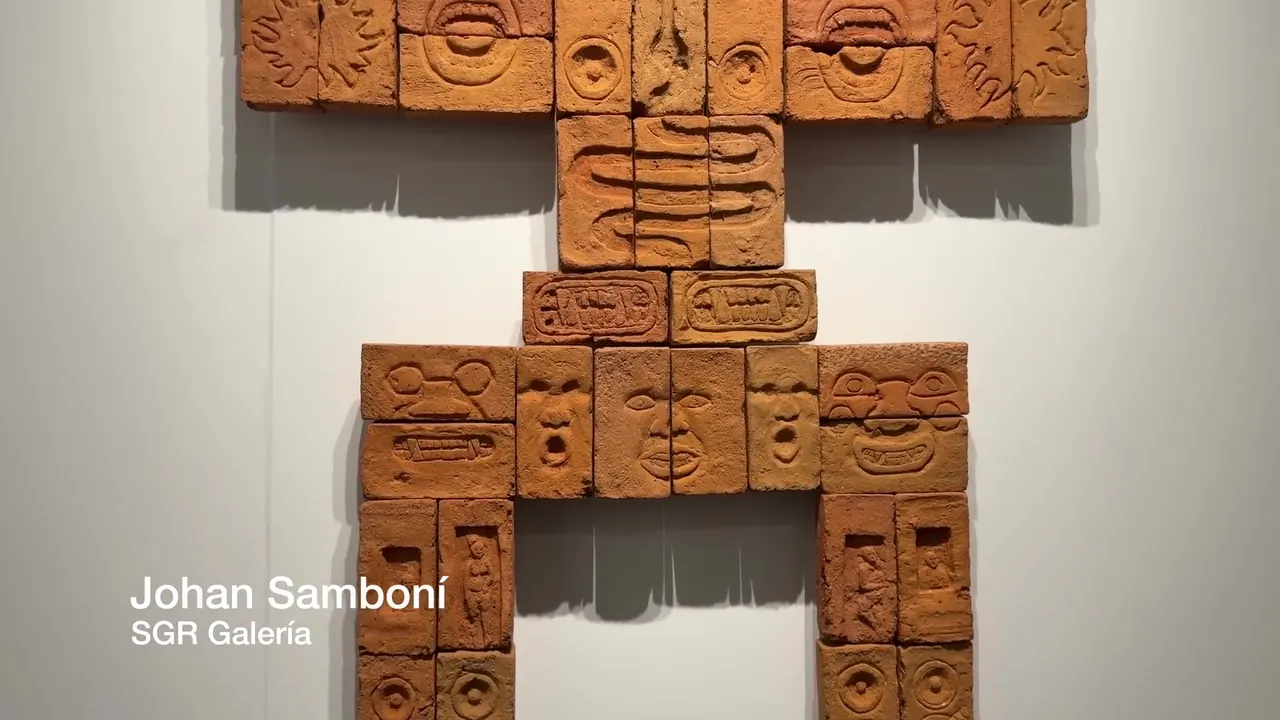
With Johan Samboni’s works at SGR Galería, it was important first to identify the medium accurately. These reddish-ochre figures and reliefs were carved from bricks, some of them placed on wooden racks. The rough grain of the brick surfaces differed subtly from the more continuous grain of the wood. Rows of heads preserved the differences between individual faces while retaining the sense of the brick as a unit. Other works assembled expressive blocks into shapes resembling outstretched limbs, allowing building component and human figure to coexist in a single work. I therefore noticed that the architectural material’s qualities of stacking, support, and incompletion had not disappeared through carving.
The organizers connected brick with the artist’s concerns about housing, life on the urban margins, and the hope of completing a home. This explanation made the material’s significance more specific and helped me avoid vague terms such as “primitive” or “totemic” to describe its forms. Larisa Sitar’s concrete works at SUPRAINFINIT shifted expectations of a different material: smooth, twisting gray forms that drooped like soft ribbons were juxtaposed with reliefs suggesting classical drapery. Knowing that Sitar works with concrete and combines traditional and digital production methods focused my attention on how a hard material can sustain an apparently soft gesture. Both booths removed architectural materials from their everyday functions while retaining their relationships with the body and social space. SGR Official Presentation SUPRAINFINIT Official Presentation
The Pace of Looking at Small Paintings and Images of Crowds
William Wright’s works at Sea View compressed night scenes, window frames, urban buildings, and everyday objects into relatively small formats. Dark backgrounds and clearly defined outer frames required me to move closer, then notice contours formed through repeated applications of paint and erasure. This slow looking differed from the effect at a distance that Ian Davis created at Galerie Judin through repeated crowds, chairs, swimming pools, and architectural structures. Davis’s figures were very small; the orderly spaces registered before the individuals did. I saw order first, then began to wonder why these people had gathered and what they were waiting for.
Neither artist needed to tell the whole story. Wright held time within layered surfaces and everyday objects; Davis used large numbers of repeated units to create the tension of an event yet to be revealed. Even while moving quickly through an art fair, this helped me distinguish works that required me to get close from those that first seized my attention through structures visible at a distance. Sea View Official Presentation Galerie Judin Official Presentation
Donyel Ivy-Royal’s images of birds in the Jack Shainman booth drew my attention to the relationship between outlines and layered surfaces. The birds’ shapes were readily recognizable, yet their bodies contained multiple images and layers of color rather than a single, smooth background. These recognizable but not entirely closed images could also be compared with Rika Minamitani’s paintings at Tomio Koyama: octopus-like curves, figures, and linear spaces met within a single picture, and cartoon-like forms did not equate to simple emotions. For me, both offered a point of entry through recognition, while allowing the narrative to become unstable in the details. Official Fair Feature on Jack Shainman Tomio Koyama Official Presentation
How Messages on Screens Acquire Authority
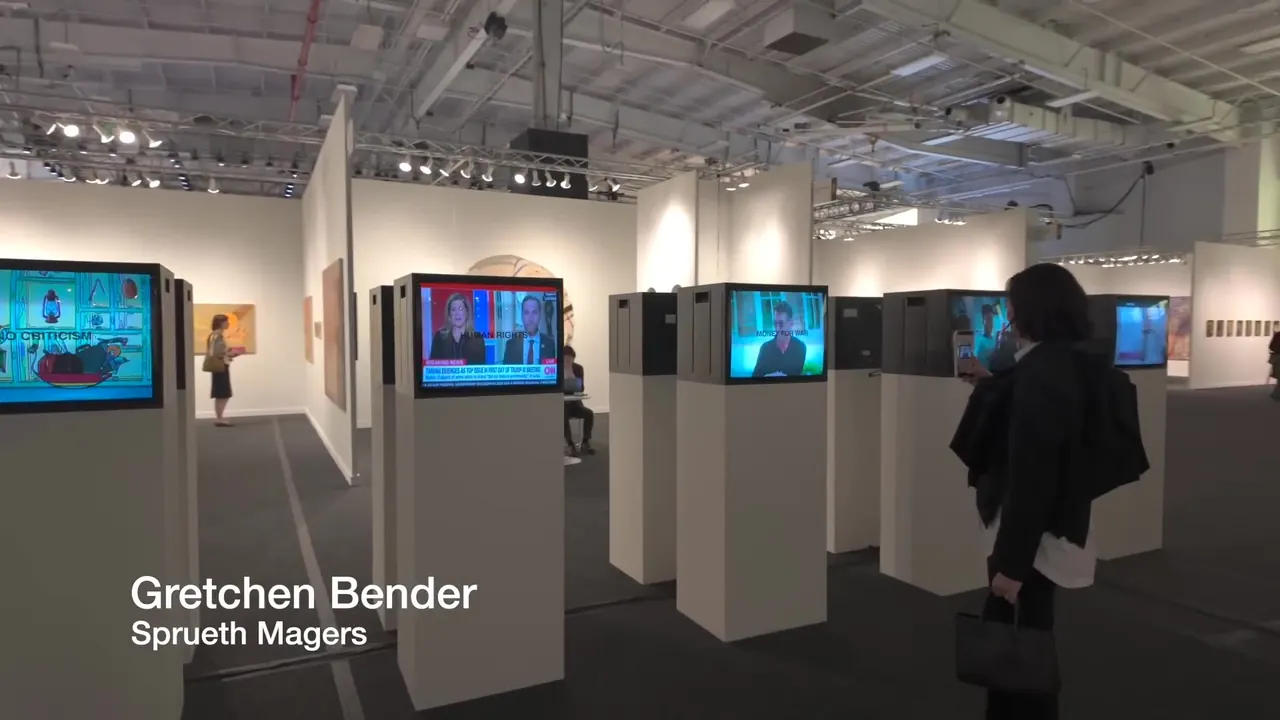
Gretchen Bender’s TV Text & Image turned my attention toward the act of looking itself. Several bulky television monitors stood on white plinths, forming a sequence that viewers could walk around from the front, sides, and back. The images continued to play, while text fixed in front of the screens established a relationship with the programs that did not fully align. Wording such as “REALITY CONTROL” was visible over the images, so news and commercial footage no longer simply passed by as a continuous stream of information. As I read the superimposed text, I had to become conscious of the tone in which the screen was speaking and whom it was addressing. The form of the medium was brought back into view, rather than leaving only the subject matter being broadcast. Sprüth Magers Official Presentation
Nina Hartmann’s works at Silke Lindner offered another point of comparison for thinking about media. Through wall works with symbol-like outlines, illuminated edges, and images at their centers, she made the content appear to possess the certainty of diagrams, signs, or ritual objects. The official description noted that she works with images from archives and different information systems, altering them through methods that include AI. My question therefore shifted from “What does this image show?” to “What forms make me willing to believe it?” Bender interrupted circulating programs with text, while Hartmann made the very appearance of evidence open to question. Silke Lindner Official Presentation
How Abstract Works Bring Supporting Structures into View
In Kikuo Saito’s gray-and-white paintings at James Fuentes, letter-like marks, wiping, and fine lines preserved the simultaneity of emergence and fading. Masanori Maeda’s works at A Lighthouse called Kanata, meanwhile, established clear boundaries through expansive blue or black forms and areas left blank. Both could quickly be classified as abstract, but I faced different questions of looking: one required me to recognize time in sparse traces, while the other brought edges, weight, and intervals to the fore.
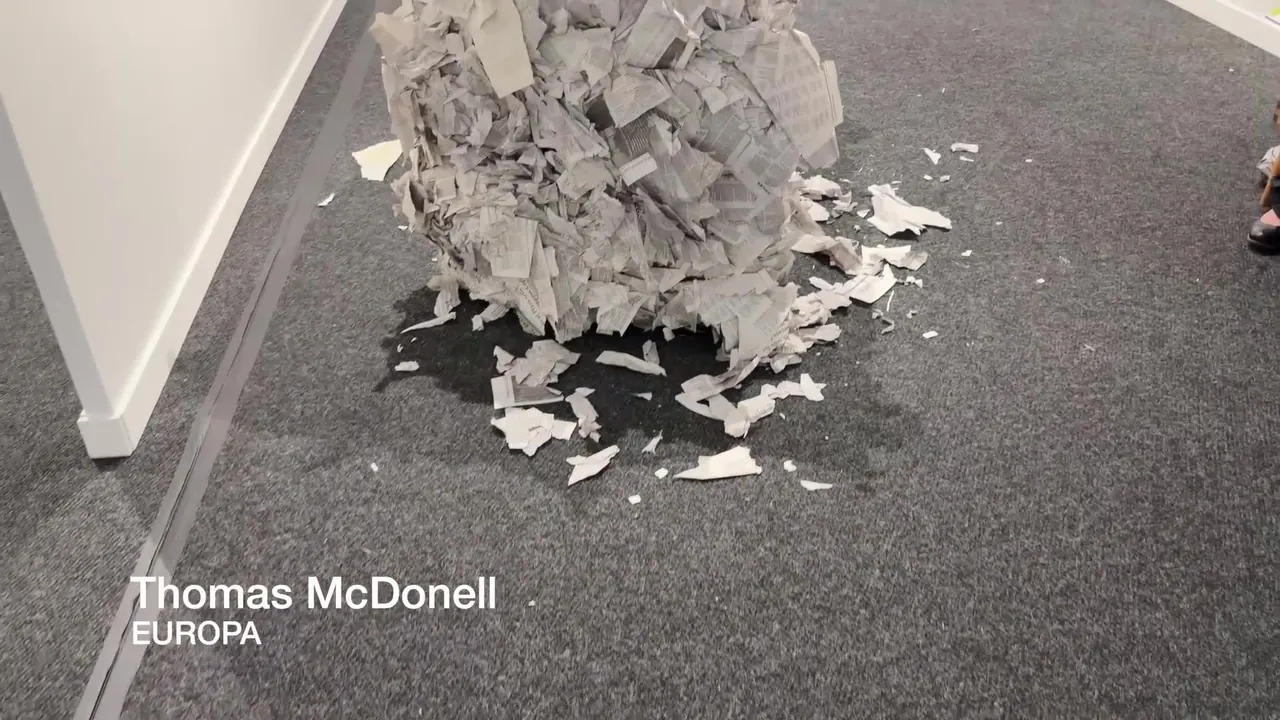
Kyojun Lee’s presentation at PIBI pushed this question toward the relationship between picture and object. Translucent planes, geometric divisions, and the box-like depth of the Void series required me to adjust my gaze among surface, frame, and interior space. The works stood at a distinct distance from the wall and could not be treated simply as flat minimalist compositions. At EUROPA, Thomas McDonell brought painting and sculpture together in a single presentation; the official materials mentioned newspapers and remnants from an abandoned curtain factory. In the booth, torn newspapers accumulated into irregular three-dimensional objects, their corners and fragments extending onto the floor, while nearby white-and-gray paintings retained wiped marks and traces of red. This juxtaposition allowed me to compare the physical weight of a medium that carries information with the almost-vanishing traces on a painting’s surface. PIBI Official Presentation EUROPA Official Presentation
Ernesto Burgos and Piotr Bury Łakomy at The Sunday Painter offered further transitions between two and three dimensions. Burgos’s colored lines moved along irregular supports that appeared folded or bent; Łakomy juxtaposed silver mesh surfaces, blue masses, and frames, so that I saw an object first and then identified the relationships between images within it. At Kerlin, Callum Innes concentrated variation at the boundary through pale fields and narrow red edges. Hazel O’Sullivan’s circular, layered wall works in the same booth used actual depth to create rhythms resembling concentric circles. Comparing planes, supports, and thickness across these examples brought my consideration of medium-based categories back to individual works. The Sunday Painter Official Presentation
How Large-Scale Sculpture and Ceramics Set the Body’s Viewing Distance
Sculpture at Independent was not all tucked away in the depths of booths. Francis Upritchard’s long-limbed figure, presented by Anton Kern, directly changed my understanding of height and bodily proportion. The organizers noted that Long Legs Long Arms go Eeling in New Zealand was connected to long-armed and long-legged figures in Japanese folklore. At ATLA, works by Yoshikazu Tanaka and Kuniko Kinoto established a different scale of looking across a long table: viewers needed to move along its edge to compare fragments, crystalline-looking surfaces, and irregular forms. The large figure made people look upward, while the small ceramics drew them closer; both consequently changed the rhythm of the main aisle. Independent 2026 Official Announcement
Keiyona Stumpf’s works at SCHENKWEITZDÖRFER used pink and dark green, along with tubular and bud-like structures, to combine an attractive appearance with a sense of unfamiliarity in the details. Bettina Pousttchi’s vividly colored three-dimensional works at Buchmann drew attention to industrial forms familiar from public space. Her Vertical Highways series transformed guardrails into upright sculptures, changing their original function of extending horizontally and directing movement. These differences kept me from treating “more three-dimensional works” as a trend in itself. Instead, I examined one by one how the works asked viewers to move, approach, or keep their distance. SCHENKWEITZDÖRFER Official Presentation Buchmann Official Presentation
Notes on the Index
Twenty-one presentations, including Comme des Garçons. The index also includes Ernesto Burgos and Hazel O’Sullivan.
Kikuo Saito / James Fuentes is recorded on the basis of the identifying on-screen label at 08:54 in the source video and contemporaneous reporting from the fair; the organizers’ earlier preview list differed. ATLA and some shared booths are recorded as joint presentations, without independently assigning unidentified individual works to particular artists.
Exhibition and Artist Index
| Artist or Creator | Gallery or Presenter | Form and Video Segment |
|---|---|---|
| Rei Kawakubo | Comme des Garçons | Clothing and pipe-frame architecture I 00:40–02:20 |
| Terri Friedman Brittany Mojo | Mindy Solomon Gallery | Color relationships between tapestries and vessels I 02:30–03:25 |
| Johan Samboni | SGR Galería | Carved-brick figures and wooden racks I 03:30–04:15 |
| Larisa Sitar | SUPRAINFINIT | Soft forms in concrete I 04:20–04:35 |
| Silvia Heyden | Charles Moffett | Rhythms of fiber in tapestry I 04:40–05:25 |
| William Wright | Sea View | Everyday objects and small, dark-toned paintings I 05:50–06:15 |
| Ian Davis | Galerie Judin | Orderly architecture and repeated crowds I 06:20–07:05 |
| Donyel Ivy-Royal | Jack Shainman Gallery | Birds and layered imagery I 07:10–07:45 |
| Kikuo Saito | James Fuentes | Letter-like marks and layers of gray and white I 08:40–09:05 |
| Nina Hartmann | Silke Lindner | Symbols, illuminated edges, and images I 09:20–09:45 |
| Ernesto Burgos Piotr Bury Łakomy | The Sunday Painter | Irregular supports, mesh surfaces, and masses I 10:10–10:35 |
| Gretchen Bender | Sprüth Magers | TV Text & Image I 10:40–11:35 |
| Masanori Maeda | A Lighthouse called Kanata | Expansive forms and areas left blank I 11:40–12:05 |
| Thomas McDonell | EUROPA | Newspaper sculpture and painting I 12:08–12:17 |
| Rika Minamitani | Tomio Koyama Gallery | Cartoon imagery and narrative space I 12:20–12:35 |
| Kyojun Lee | PIBI Gallery | Divided planes and Void box forms I 12:50–13:25 |
| Keiyona Stumpf | SCHENKWEITZDÖRFER | Organic ceramic forms I 14:10–14:55 |
| Yoshikazu Tanaka Kuniko Kinoto | ATLA | Ceramic fragments and fired forms I 15:00–15:20 |
| Francis Upritchard | Anton Kern Gallery | Long-limbed figurative sculpture I 15:30 |
| Bettina Pousttchi | Buchmann Galerie | Transformed guardrails and public space I 16:00–16:38 |
| Callum Innes Hazel O’Sullivan | Kerlin Gallery | Pale fields with red edges and concentric-circle wall works I 16:40–17:15 |
Sources and reference links 21
- Independent 2026 official announcement
- Mindy Solomon official presentation
- Charles Moffett official presentation
- SGR official presentation
- SUPRAINFINIT official presentation
- Sea View official presentation
- Galerie Judin official presentation
- Jack Shainman official fair essay
- Tomio Koyama official presentation
- Sprüth Magers official presentation
- Silke Lindner official presentation
- PIBI official presentation
- EUROPA official presentation
- The Sunday Painter official presentation
- SCHENKWEITZDÖRFER official presentation
- Buchmann official presentation
- James Fuentes
- A Lighthouse called Kanata
- ATLA
- Anton Kern Gallery
- Kerlin Gallery