07 / 19 · The work of auction houses
Inside auction houses: before and after the hammer
If bidding lasts only minutes, what work brings an artwork to the hammer and through to handover?
In this chapter
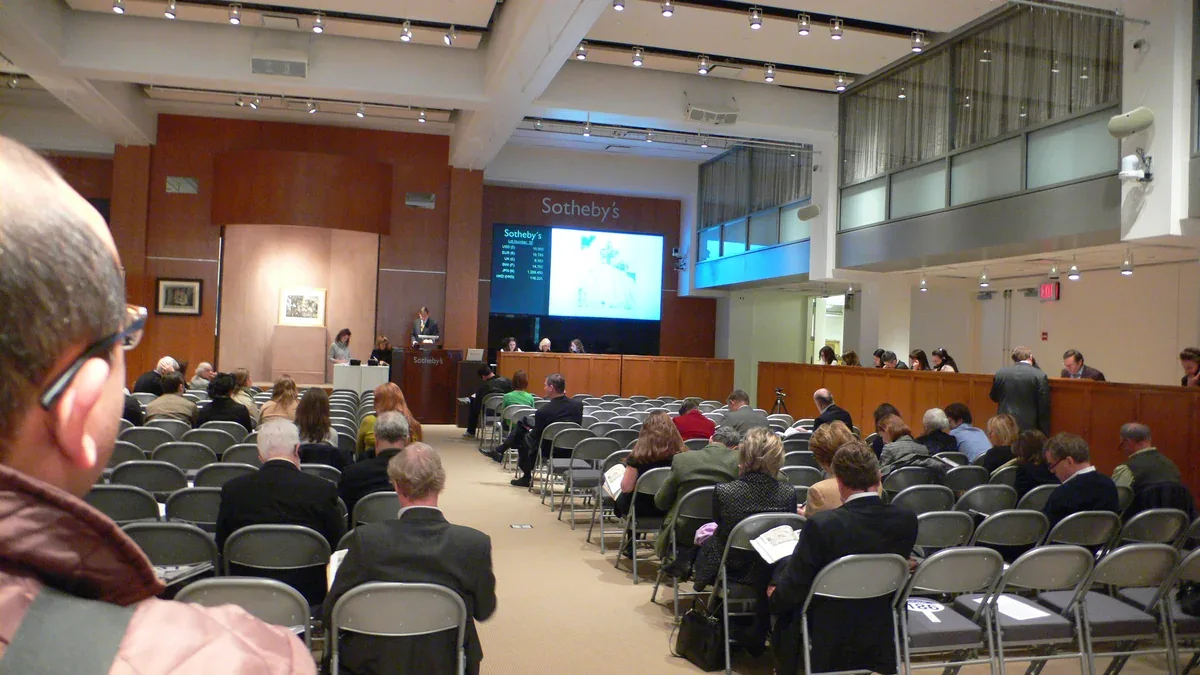
News coverage often presents auctions through raised paddles, final calls and the falling hammer. The work supporting the transaction extends much further. Consignors supply objects and documents; specialists research them; teams organise display, communication and logistics. Payment, settlement and handover follow a sale. The auction house coordinates this sequence.
This chapter follows the institution and the object: who supplies which information, and who is responsible at each stage? That route helps us read catalogues and sale reports, and understand how an unsold lot, a withdrawal or a private sale can enter a work’s history.
An artwork’s auction route
Six stages from consignment to handover
Consignment
Identify the work and selling authority
Supply object information and discuss the channel, timing and consignment terms.
Research
Develop records and examine condition
Specialists examine provenance, object information and related records to form pre-sale opinions.
Catalogue
Publish the lot and relevant information
Present the description, estimate, terms and symbols requiring attention.
Preview
Enable viewing and questions
Physical or remote viewing supplements images; staff answer questions about records and condition.
Auction
Record bidding and the outcome
The sale rules determine sold or unsold outcomes; withdrawals are distinguished separately.
Post-sale
Payment, settlement and handover
Reconcile charges and payment, then coordinate seller settlement and buyer collection under the terms.
A common sequence; arrangements vary, and research or terms may be updated along the way.
An auction is a mechanism; an auction house is an institution
A public auction offers particular works at a scheduled time, with bidding creating the opportunity for a sale. An auction house may also offer private sales, valuations and other services. Specialisms, regions and scale vary. To understand the institution, examine how it obtains consignments, identifies works and reaches relevant audiences, beyond brand names and record-price rankings.
Auctions frequently offer previously collected works, but the mechanism does not determine whether a sale is primary or secondary. An artist’s first sale can take place at auction, while an auction house’s private transaction may be a resale. Large firms and regional houses alike need to connect knowledge of the work with the buyers they can reach.
A comparison can therefore begin with the knowledge a work requires: is there relevant expertise in its medium, period or region? The same institution may organise different sales for different collecting interests. The drama of an evening auction is one presentation format. Understanding everyday operations also requires attention to ordinary consignments and local needs.
Consignment begins a record of the work and responsibilities
A consignor might be a collector, an estate representative or another authorised seller. Initial photographs, dimensions, provenance and documents help specialists judge whether a work suits a selling channel. Further examination may add to or alter that first assessment. Acceptance also involves timing, estimates, costs, custody and arrangements if the work remains unsold, confirmed in the relevant agreement.
The auctioneer is visible during a live sale but does not carry the transaction alone. Specialists and researchers develop context; registrars and logistics staff track location and condition; client services coordinate communication; finance teams handle accounts. The purpose of this division is to keep identity, documents and the physical object aligned, with a responsible person available for each question.
Catalogues document works and frame their presentation
A catalogue assigns a lot identity and typically records maker, date, medium, dimensions and relevant provenance, exhibitions and publications. Distinguish object information, attribution language and the accompanying essay. A vivid art-historical account does not establish complete documentation for every detail. Identify which evidence refers directly to this work, beyond the promotional headline.
A condition report focuses on physical state and may describe damage or treatment. It answers different questions from provenance. A preview enables viewers to examine scale, surfaces and presentation, supplementing photographs. Sale category, sequence and promotion also shape which audiences encounter a work. These form part of its selling context rather than a final art-historical judgment.
A catalogue may become a source for later research, but its date matters. Subsequent exhibition records, scholarship or attribution opinions can revise an earlier description. Recording the sale date, sale identity and lot number links a claim to its original record and distinguishes what was known then from knowledge acquired afterwards.
Estimate, reserve and guarantee answer different questions
An estimate is a pre-sale opinion about a likely price range, informed by the work and comparable transactions. It is neither the final result nor a promise about future prices. A reserve is the minimum selling threshold agreed with the consignor and is usually confidential. One communicates expectations to the market; the other sets a condition for selling.
A price guarantee requires a separate agreement and may involve the auction house or a third party. A high estimate does not establish its existence. Even where present, a guarantee allocates risk in a particular consignment; it does not promise the buyer that the work will retain its value. Catalogue symbols and terms may disclose financial interests, helping readers identify roles beyond bidding.
The roles clarify these distinctions. A specialist provides a market opinion, the consignor negotiates selling conditions, and a guarantor assumes specified risks by agreement. All three can coexist without serving the same purpose. For any number, ask who supplied it and what it is for, rather than treating every figure as the work’s single definitive value.
A sale is a milestone followed by handover
An auctioneer leads a live sale, while online-only sales close according to the platform and sale rules. A lot can sell, remain unsold below reserve or be withdrawn before sale. Record these outcomes separately. A later private transaction may follow an unsold lot, but it cannot be retroactively treated as the original auction result. Market history includes these distinct events and dates.
For a sold lot, the hammer price is the bid amount. The buyer’s total may also include a buyer’s premium, taxes and other charges; the seller’s net proceeds reflect commission and agreed expenses. Post-sale teams coordinate receipt of payment, settlement, collection or shipping. The falling hammer does not mean cleared funds or completed delivery; progress remains subject to payment and the relevant conditions.
Public records make markets researchable, not fully transparent
Auction results offer traceable events for comparing works and selling contexts. They do not represent the whole market: private transactions, works never offered and undisclosed terms may be absent. Databases can also differ in their treatment of fees, exchange rates and unsold outcomes. A few conspicuous prices do not represent every work by an artist.
Auction houses combine expertise, marketing, transactions and logistics while pursuing the commercial goals of securing consignments and completing sales. Recognising both roles helps us use their information while understanding its scope. Ask which work sold, under what conditions and how the reported amount was defined. That is the starting point for turning a headline into knowledge.
When building a comparison, define the question and scope first. Tracing one series requires a different sample from studying a location’s auctions in a given year. Selecting only sold works obscures the unsold part of a sale; mixing media and periods can turn differences between objects into an apparent market movement. Public data are useful in relation to how they are organised.
How does a lot pass between teams?
Thinking of an auction as a sequence of handovers makes work beyond the hammer visible. Consignment staff understand the seller’s needs, specialists identify the object and prepare its catalogue entry, marketing teams introduce it to interested audiences, and sale and post-sale teams handle bidding and delivery. Each handover needs a shared object identifier and updated records; otherwise photographs, documents and conversations can describe different versions of the same lot.
This perspective also helps buyers direct the right questions to the right people. Surface restoration calls for condition information, while payment, collection and shipping require post-sale arrangements. Christie’s buyer resources explain condition reports and bidding methods separately, showing why reading a catalogue is only one step. Preparation includes knowing which information is already available and what must be clarified before acting.
READING COMPANION
A few useful terms
- Consignor
- The person or organisation authorising an auction house to sell a work on its behalf.
- Lot
- An object or group offered as one sale unit, usually with an identifying number.
- Estimate
- A pre-sale opinion of a likely price range, not a promise of sale or retained value.
- Reserve
- The minimum selling threshold agreed in advance with the consignor, usually confidential.
- Hammer price
- The final accepted bid for a sold lot, excluding buyer’s premium.
YOUR TURN
What three kinds of question remain after a painting is reported as selling above estimate?
Consider another way to think about it
First ask about the work: period, series and condition. Then examine the figures: are estimate and result reported on the same fee basis? Finally ask about scope: is this one transaction, or are there enough comparable works? These questions turn an exciting headline into a checkable observation.
TAKE THIS THOUGHT WITH YOU
Research, responsibilities and handover on either side of the hammer determine how an auction result should be understood.
Reading notes & references
Art Value Lab adapted this chapter from art-business course materials and the supplied Christie’s Education slides An Introduction to the Art World. Institutional descriptions and cases were checked against public sources.
- Christie’s — Selling Guide
- Sotheby’s — Buy & Sell
- Christie’s — Auction Terminology
- Christie’s — What is an auction estimate?
- Christie’s — What are condition reports?
- Christie’s — Financial Information
- Sotheby’s — Giving Artists an Edge on the Market with Artist’s Choice (2022)
- Christie’s — Auction help library
FURTHER READING · 3 FEATURES
BEYOND CHAPTER 07
How do auction prices climb?
Read the rules and blind spots: from bidding and guarantees to payment, distinguish numbers, evidence and inference.
Read the featureBEYOND CHAPTER 07
From consignment to the saleroom: reading prices, guarantees and disclosures
Follow a work through consignment, bidding and settlement to understand fees, reserves, guarantees, withdrawal statistics and New York’s 2022 regulatory changes.
Read the featureBEYOND CHAPTER 07
Why do handbags, watches and art share an auction house?
Explore brands, craft and cross-collecting, and distinguish knowing a model from understanding an object and assessing a transaction.
Read the featureConnect the ideas
Continue into people, works and research.
Put the process into practice
Continue into catalogues, consignment, bidding and post-sale work.
Continue readingWhat can auction figures tell us?
Read research with questions about reporting methods and unsold works.
Continue readingRevisit how value is assessed
Distinguish estimates, sale results and other kinds of value.
Continue reading